> For the complete documentation index, see [llms.txt](https://developer.harness.io/llms.txt). Markdown versions of documentation pages are available by appending `.md` to page URLs; this page is available as [Markdown](https://developer.harness.io/continuous-delivery/troubleshooting-and-resources/resources/service-licensing-for-cd.md).
# CD service licensing
How Harness CD module tracks and consumes service-based licensing
The Harness Continuous Delivery and GitOps (CD) module uses services as the core construct for defining and managing the software you deploy. Services represent the deployable units of your applications, whether they are containerized workloads, traditional virtual machines, serverless functions, or custom deployment targets.
Harness offers two licensing models for CD: a legacy service-based model where you license by active services directly, and the Developer 360 model where you license by developers and receive service entitlements as part of that subscription. Both models only count services that have been deployed within the last 30 days, ensuring you pay only for what you actively use. Go to [Subscriptions and licenses](/harness-ai/subscriptions-and-licenses/subscriptions.md) to understand the broader Harness licensing framework and how Developer 360 works across modules.
***
### What you will learn
* **Service definition:** How Harness defines a service across different deployment types (Kubernetes, VMs, serverless, GitOps, custom).
* **Active service window:** What makes a service count as active (30-day deployment window) and how service instances are tracked.
* **License consumption ratios:** How different deployment types consume service licenses (containerized, traditional, serverless, custom, GitOps).
* **95th percentile calculation:** Why Harness uses the 95th percentile of service instances to ignore temporary spikes and keep licensing fair.
* **Service tracking improvements:** Recent enhancements to tracking (GitOps services, serverless valuation, pipeline executions without services).
***
### Service
The CD module deploys software services to infrastructure platforms spanning traditional VMs, Kubernetes, public cloud platforms, serverless functions, and other custom deployment targets. A service is an independent unit of software you track and manage through Harness CD and GitOps.
A Harness CD service typically maps to one of the following:
* A service in Kubernetes (a deployment, statefulset, or daemonset)
* An application synced via GitOps to a unique infrastructure destination
* A containerized service on a cloud platform such as AWS ECS or Azure Container Instances
* A virtual machine in traditional VM-based applications
* A serverless function in environments such as AWS Lambda or Google Cloud Functions
* A custom definition (Harness CD allows custom service definitions for unsupported platforms)
***
### Active service
Services deployed using the CD module in the **last 30 days** are considered **active services**. Both the service-based and Developer 360 licensing models only consume licenses for active services. This means services created and deployed more than 30 days ago no longer consume any licenses with Harness CD, ensuring license consumption reflects only active usage.
**Service lifecycle after 30 days:** When a service has not been deployed for more than 30 days, it stops consuming a license. If you redeploy that service later, it becomes active again and resumes consuming a license. The service identity is preserved, so redeployment does not count it as a new service for license tracking purposes.
**Service renaming and migration:** Renaming a service in Harness preserves its license tracking history. If you delete a service and recreate it with the same name, Harness treats it as a new service for license tracking purposes, and its 30-day activity window starts fresh.
***
### Service instances
Service instances (SIs) refer to the pods or instances of a service deployed to a host. The CD module continuously tracks the instances of each service deployed, at a 60-minute cadence, allowing administrators to monitor these instances and service versions across different infrastructure hosts.
Service instances play a key role in how license consumption works:
* **Tracking cadence:** Harness tracks all service instances for all deployed services every 60 minutes.
* **95th percentile calculation:** When reporting for license consumption, Harness takes the **95th percentile** of all SI data points seen over the last 30 days for the service and uses this value as the number of service instances. This approach is beneficial because it ignores temporary spikes in instance counts. The top 5 percent of your highest instance counts are excluded, so activities like load testing, blue-green deployments, or other temporary scaling events do not artificially inflate your license usage. Licensing stays true to your steady-state instance counts.
* **License consumption:** For most deployment types, one service license is consumed for every 20 service instances (see exceptions below for serverless and custom deployments).
***
### Service license consumption for active services
Only active services (services deployed in the last 30 days) consume one or more service licenses. The following sections explain how Harness CD consumes service licenses across different deployment scenarios.
#### Containerized applications
Harness CD deploys containerized services to architectures such as Kubernetes, Amazon ECS, Tanzu Application Services, and Azure WebApps. In all these architectures, Harness tracks pods of services as service instances, as explained in the section above. Service instances are tracked the same way whether a service is deployed using pipelines or synced using GitOps.
**License consumption:** Harness CD consumes 1 service license for every 20 service instances of a service.
**Examples:**
* A CD service running 5 service instances (95th percentile of last 30 days of instance tracking) will consume 1 service license.
* A CD service running 25 service instances (95th percentile of last 30 days of instance tracking) will consume 2 service licenses.
#### Traditional (non-containerized) applications
Harness deploys traditional VM-based applications (non-containerized) to architectures such as Amazon AMI/ASG, Azure WebApps, and WinRM or SSH to VMs. In all these architectures, Harness tracks instances of the service as every VM deployed.
**License consumption:** Harness CD consumes 1 service license for every 20 service instances of a service.
**Examples:**
* A CD service running 5 service instances will consume 1 service license.
* A CD service running 25 service instances will consume 2 service licenses.
#### Serverless functions
Harness deploys serverless functions to architectures such as AWS Lambda, AWS SAM, Google Cloud Functions, Serverless.com Framework, and Azure Functions. In all these architectures, Harness does not track instances of functions deployed, since serverless functions scale dynamically and instance counts are not meaningful for license tracking.
**License consumption:** Harness CD consumes 1 service license for every 5 unique functions deployed.
**Examples:**
* 5 unique functions deployed in the last 30 days will consume 1 service license.
* 25 unique functions deployed in the last 30 days will consume 5 service licenses.
#### Custom deployments
Harness allows custom deployments using deployment templates to support deployments to architectures not yet natively supported by Harness CD. From a license tracking perspective, Harness encourages all customers to configure an instance fetch script as part of the custom deployment, which returns the instances of this service deployed on the target architecture.
There are two scenarios:
**Instance fetch script is configured:** The instance fetch script is properly configured and Harness has steady visibility to all service instances for the service.
Harness CD consumes 1 service license for every 20 service instances of the custom service.
**Instance fetch script is not configured:** The instance fetch script is not properly set up or functioning as expected, and Harness has no visibility to service instances for the service.
Harness CD consumes 1 service license for each active custom service.
#### Pipelines with no service
Harness allows custom deployments where no service is associated with the deployment. This can happen when a pipeline execution only runs infrastructure provisioning steps, only performs shell script executions, or runs a custom stage with the environment configured but no service. In all these scenarios, the lack of service configuration means Harness loses the default license tracking.
**License consumption:** Harness CD consumes 1 service license for every 2000 executions of such custom stages.
Custom stages are more than a logical division. Each custom stage counts as one pipeline execution. For example, if a pipeline has two custom stages, then executing that pipeline will use 2 executions in relation to service license consumption.
***
### View your license usage
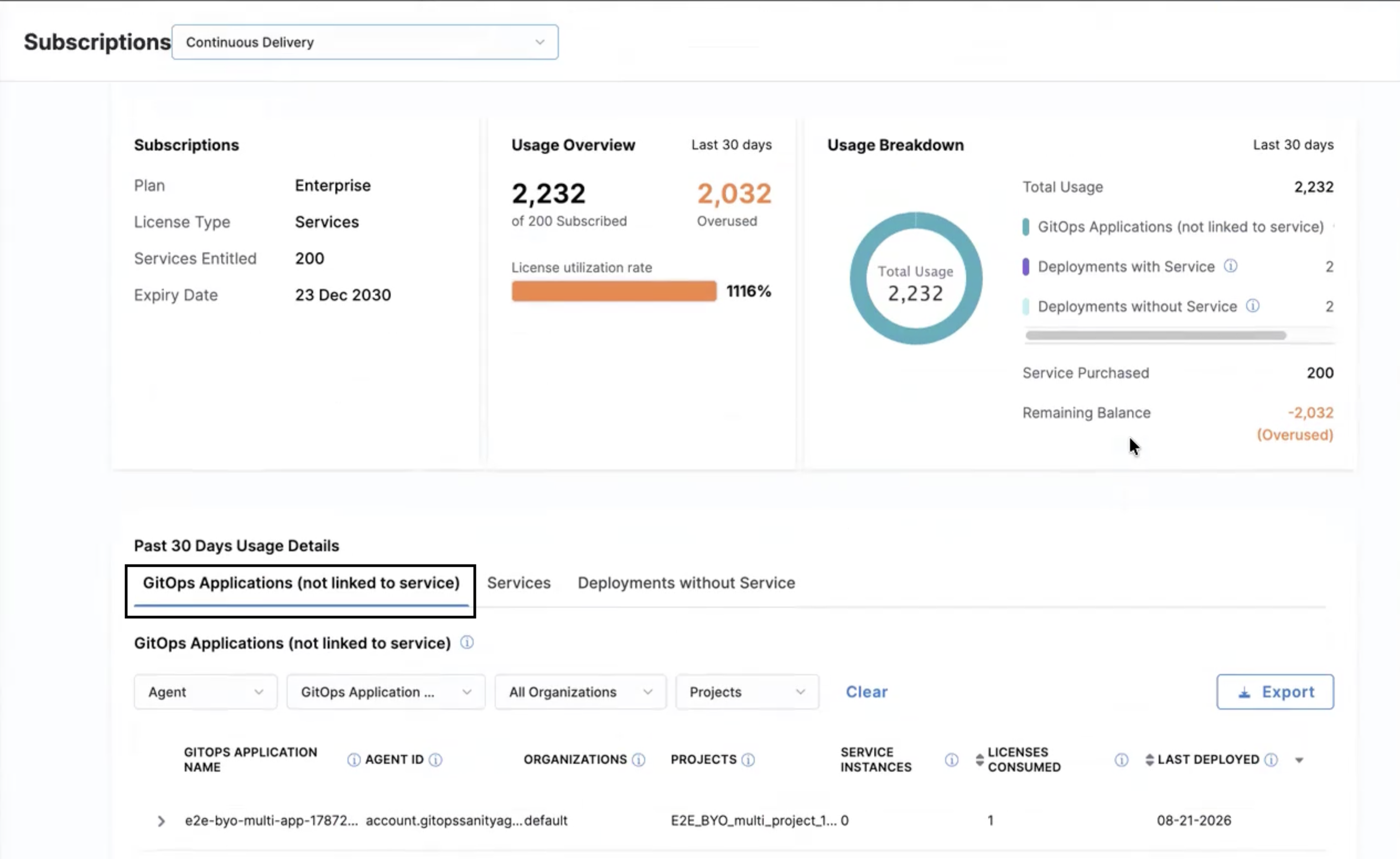
Harness provides visibility into your service license consumption through the subscription management interface. To view your current license usage, navigate to **Account Settings** and select **Subscriptions** in the Harness Platform. This page displays your licensed service count, current consumption, and usage trends over time.
**Who can view license data:** Only users with account-level permissions can access subscription and license usage data. Account administrators can assign these permissions through RBAC roles. Go to [RBAC in Harness](/harness-ai/use-harness-platform/platform-access-control.md) to understand permission management and [Manage roles](/harness-ai/use-harness-platform/platform-access-control/add-manage-roles.md) to configure access for your team.
**License usage metrics:** The subscription page shows active services by deployment type, service instances tracked, and historical consumption trends. This helps you understand where your license usage is coming from and identify opportunities for optimization.
#### Subscription page walkthrough
The subscription page provides an intuitive interface for visualizing what services are being tracked, giving you greater visibility and control over your deployments. You can view real-time data on active services, service instances, and how your consumption aligns with your licensed capacity.
The following video demonstrates how to navigate the subscription page and interpret license usage data:
{% embed url="" %}
**Key features shown in the video:**
* Navigating to the subscription page from Account Settings
* Understanding the breakdown of active services by deployment type
* Viewing service instance counts and the 95th percentile calculation
* Monitoring consumption trends over the last 30 days
* Identifying which projects and services are consuming licenses
***
| Component | Service Tracking (Past State) | Service Tracking (New State) | Change Details |
| ------------------------------------------------ | ----------------------------------------------------- | ------------------------------------------------- | ------------------------------------------------------------------------------------------------------------------------------------------------------------------------------------------------------------------------------------------------------------------------------------------------------------------------- |
| **CD Service** | 1 Service = 20 SI | 1 Service = 20 SI | No change in licensing rules. |
| **GitOps Service** | Not measurable by customer, not calculated in product | 1 GitOps Service = 20 SI (1 Service) | New service tracking introduced for GitOps Services. With the `CDS_GITOPS_SERVICE_BASED_LICENSING` feature flag, Applications linked to a Harness Service use the Service for license calculation. Go to [GitOps service-based licensing](#gitops-service-based-licensing) to learn how this affects license calculation. |
| **Pipeline Execution (Deployments w/o Service)** | Not measurable by customer, not calculated in product | 2000 Executions = 1 Service | New service tracking introduced for Deployments without service. Specifically, per Stage Execution. If a Pipeline has 5 Stages with no service being deployed, we bill 5 Executions. |
| **Serverless Services** | 1 Function = 1 Service | 1 Function = 0.2 Service For SI based - No Charge | Adjusted valuation to 0.2 Service per function. |
Harness does not block deployments when you exceed your licensed service count. If your active service count grows beyond your purchased license capacity, your account continues to function normally, and all pipelines and deployments execute without interruption.
### GitOps service-based licensing
By default, Harness calculates CD license usage based on **Services**, but calculates GitOps license usage based on **Applications**. This can cause a usage discrepancy when the same service deploys to multiple environments through separate GitOps Applications, because each Application counts independently toward license consumption even though they share the same underlying service and manifests.
To address this, Harness offers service-based licensing for GitOps behind the `CDS_GITOPS_SERVICE_BASED_LICENSING` feature flag. When this feature flag is enabled, Harness uses the following logic to calculate GitOps license usage:
* **Application linked to a Harness Service:** Harness uses the linked Service for license calculation, consistent with how CD licensing works. Multiple Applications that share the same Service count as a single Service for licensing purposes.
* **Independent Application (no service linkage):** Harness continues to use the existing Application-based model. Each independent Application counts separately toward license consumption.
#### Active service window for GitOps service-based licensing
When service-based licensing is enabled, a service is considered active if any GitOps application linked to that service has been synced within the previous 30 days. This includes both pipeline-driven syncs and direct application syncs initiated from the GitOps Applications page.
For example, suppose a service is linked to three GitOps applications across different environments. If any one of those applications is synced, either through a pipeline or directly, the service is considered active for the applicable 30-day period.
Once a service is identified as active, Harness applies the standard 95th percentile calculation across all service instances.
This approach ensures that GitOps activity is reflected in license calculations regardless of whether the sync is initiated through a pipeline or directly from the GitOps Applications page.
#### Subscription dashboard display
When the `CDS_GITOPS_SERVICE_BASED_LICENSING` feature flag is enabled, the subscription dashboard displays GitOps license usage in separate tabs within the **Past 30 Days Usage Details** section:
* **Services:** Displays GitOps applications that are linked to Harness services and are included in service-based licensing.
* **GitOps Applications (not linked to service):** Displays independent GitOps applications that are not linked to a Harness service and are included in application-based licensing.
This separation provides visibility into how GitOps applications contribute to license consumption under the different licensing models.
{% hint style="info" %}
**ENABLE SERVICE-BASED LICENSING FOR GITOPS**
To enable service-based licensing, contact [Harness Support](mailto:support@harness.io) and request the `CDS_GITOPS_SERVICE_BASED_LICENSING` feature flag. After activation, any GitOps Application linked to a Harness Service uses that Service for license calculation instead of counting the Application separately.
To link GitOps Applications to a Harness Service, go to [Linking Applications to a Service](/continuous-delivery/use-gitops/gitops-entities/service/service.md#linking-applications-to-a-service).
{% endhint %}
***
### Customer FAQs for the improved Service Tracking
**Visibility and alerts:** The subscription page displays an over-limit indicator when your consumption exceeds your licensed capacity. Account administrators receive notifications through the Harness Platform to alert them of the overage.
**Contract adjustments:** When you consistently exceed your licensed capacity, your account team will work with you to adjust your contract to match your actual usage and needs. Harness is committed to making this process transparent and collaborative. License increases are not automatic upcharges. Instead, Harness works with you to understand your usage patterns and ensure your subscription aligns with your deployment scale.
**Optimization opportunities:** If you want to reduce service license consumption before contract renewal, you can identify inactive services, consolidate similar deployments, or review your deployment architecture. The subscription page provides detailed usage data to help you identify optimization opportunities. Go to the subscription page walkthrough section above for guidance on using these metrics.
***
### Improved service license tracking
Harness has enhanced service tracking capabilities to provide more accurate visibility into what is being deployed and managed through the CD module. These improvements ensure that billing reflects the comprehensive set of features you use, promoting fairness and transparency.
The following table summarizes the changes:
| Component | Service Tracking (Past State) | Service Tracking (Current State) | Change Details |
| ---------------------------------------------------- | ----------------------------------------------------- | -------------------------------------------------- | -------------------------------------------------------------------------------------------------------------------------------------------------------------------------------------- |
| **CD Service** | 1 Service = 20 SI | 1 Service = 20 SI | No change in licensing rules. |
| **GitOps Service** | Not measurable by customer, not calculated in product | 1 GitOps Service = 20 SI (1 Service) | New service tracking introduced for GitOps Services. |
| **Pipeline Execution (Deployments without Service)** | Not measurable by customer, not calculated in product | 2000 Executions = 1 Service | New service tracking introduced for deployments without a service. Specifically, per stage execution. If a pipeline has 5 stages with no service being deployed, we bill 5 executions. |
| **Serverless Services** | 1 Function = 1 Service | 1 Function = 0.2 Service (For SI-based, no charge) | Adjusted valuation to 0.2 Service per function. |
**GitOps service tracking:** GitOps has become a core feature of Harness CD and is widely adopted by customers. Including GitOps services in the billing model ensures that billing accurately reflects the comprehensive set of features you use.
**GitOps multi-cluster scenarios:** A GitOps application synced to multiple clusters using ApplicationSets or multiple sync destinations counts as one service if it deploys the same workload definition. Each unique infrastructure destination counts separately for service instance tracking. For example, an application synced to three Kubernetes clusters counts as one service, but the pod counts across all three clusters contribute to the total service instance count for the 95th percentile calculation.
**Serverless valuation adjustment:** By adjusting the valuation to 0.2 of a service per serverless function (or 1 service for every 5 functions), customers deploying serverless architectures experience reduced costs associated with these functions. This change makes it more cost-effective to leverage serverless deployments.
***
### Frequently asked questions If I deploy a service but it generates 0 service instances, will it still count toward my active service usage?
Yes. Even if your service does not create any service instances, it will still be considered active because it was used in a Deploy stage. Harness will count and charge for 1 active service in this case.
If my pipeline fails, will the service still count as active?
Yes, even if your pipeline fails, the service will still count as active and will be included in your license usage \[[CD service licensing](https://developer.harness.io/docs/continuous-delivery/cd-onboarding/service-licensing-for-cd/#frequently-asked-questions)].
Once a service is deployed—regardless of whether the deployment succeeds or fails—it is marked as active. Harness calculates service licenses based on active service instances deployed in the last 30 days, which explicitly includes services from both successful and failed deployments \[[CD service licensing](https://developer.harness.io/docs/continuous-delivery/cd-onboarding/service-licensing-for-cd/#frequently-asked-questions); [General FAQs](https://developer.harness.io/docs/continuous-delivery/kb-articles/faqs#how-do-you-determine-the-number-of-service-instanceslicenses-for-our-services)].
Will service tracking improvements increase my costs?
Under the new Harness CD service tracking improvements, the changes **may increase your license consumption** because more deployable items (such as GitOps services and deployments without a service) are now being tracked \[[CD License FAQ](https://developer.harness.io/docs/continuous-delivery/cd-onboarding/service-licensing-for-cd/#frequently-asked-questions)].
However, Harness has clarified that this model is designed to better track license utilization across all customers, and **it is not intended to automatically increase your costs** \[[CD License FAQ](https://developer.harness.io/docs/continuous-delivery/cd-onboarding/service-licensing-for-cd/#frequently-asked-questions)].
Here are the key details regarding cost impact:
* **No Automatic Upcharging:** Harness has committed to not upcharging you based on increased utilization from this tracking model \[[CD License FAQ](https://developer.harness.io/docs/continuous-delivery/cd-onboarding/service-licensing-for-cd/#frequently-asked-questions)]. If your usage consistently exceeds your licensed capacity, your account team will work collaboratively with you to adjust your contract rather than applying automatic penalty charges \[[Contract adjustments](https://developer.harness.io/3k-docs/continuous-delivery/cd-onboarding/service-licensing-for-cd/#customer-faqs-for-the-improved-service-tracking)].
* **Usage-Based Billing:** You are only billed for the features you actually use \[[CD License FAQ](https://developer.harness.io/docs/continuous-delivery/cd-onboarding/service-licensing-for-cd/#frequently-asked-questions)]. If you do not use features like GitOps or Serverless Functions, they will not contribute to your license consumption \[[CD License FAQ](https://developer.harness.io/docs/continuous-delivery/cd-onboarding/service-licensing-for-cd/#frequently-asked-questions)].
* **Serverless Cost Reductions:** If you utilize serverless architectures, your license consumption for these workloads will actually decrease. The valuation has been reduced from 1 full Service per function to 0.2 of a Service per function (meaning 5 functions now equal 1 Service license) \[[Serverless valuation adjustment](https://developer.harness.io/docs/continuous-delivery/cd-onboarding/service-licensing-for-cd/#improved-service-license-tracking)].
* **Grace Period:** Your existing contract remains completely unchanged until your renewal \[[CD License FAQ](https://developer.harness.io/docs/continuous-delivery/cd-onboarding/service-licensing-for-cd/#frequently-asked-questions)]. This gives you time to review your usage data, adjust your workflows, and optimize your deployment architecture before the new terms take effect \[[Grace Period Info](https://developer.harness.io/docs/continuous-delivery/cd-onboarding/service-licensing-for-cd/#customer-faqs-for-the-improved-service-tracking)].
If you have specific concerns about how these tracking improvements might impact your bill, it is recommended to reach out directly to your **Harness account representative** to analyze your usage patterns \[[CD License FAQ](https://developer.harness.io/docs/continuous-delivery/cd-onboarding/service-licensing-for-cd/#frequently-asked-questions)].
Why has tracking for GitOps services been introduced in the new service tracking improvements?
Tracking for GitOps services was introduced in the new service tracking improvements because GitOps has become a core feature of Harness Continuous Delivery (CD) and is widely adopted by customers. Including GitOps services in the billing model ensures that billing accurately reflects the comprehensive set of features being utilized, promoting **fairness and transparency** \[[CD Services FAQ](https://developer.harness.io/docs/continuous-delivery/cd-onboarding/service-licensing-for-cd/#frequently-asked-questions); [Improved service license tracking](https://developer.harness.io/docs/continuous-delivery/cd-onboarding/service-licensing-for-cd/#improved-service-license-tracking)].
Under this current tracking model, **1 GitOps Service is equivalent to 20 Service Instances (SI)**, which is equal to 1 standard CD Service. Previously, GitOps services were not measurable by customers and were not calculated in the product at all \[[CD Services FAQ](https://developer.harness.io/docs/continuous-delivery/cd-onboarding/service-licensing-for-cd/#frequently-asked-questions)].
How does the change in serverless services valuation benefit me?
The change in serverless services valuation benefits you by **significantly reducing the licensing costs** associated with serverless deployments \[[CD Services FAQ](https://developer.harness.io/docs/continuous-delivery/cd-onboarding/service-licensing-for-cd/#service-license-consumption-for-active-services)].
Here is how the valuation has improved:
* **Old Model:** Each deployed serverless function was counted as **1 full Service license** (e.g., deploying 25 unique serverless functions consumed 25 Service licenses) \[[CD Services FAQ](https://developer.harness.io/docs/continuous-delivery/cd-onboarding/service-licensing-for-cd/#service-license-consumption-for-active-services)].
* **New Model:** The valuation has been adjusted so that each serverless function is now counted as only **0.2 of a Service license**. This means **5 unique functions consume only 1 Service license** \[[CD Services FAQ](https://developer.harness.io/docs/continuous-delivery/cd-onboarding/service-licensing-for-cd/#service-license-consumption-for-active-services)].
#### Example Comparison
* **Old model:** 25 serverless functions = 25 Service licenses \[[CD Services FAQ](https://developer.harness.io/docs/continuous-delivery/cd-onboarding/service-licensing-for-cd/#service-license-consumption-for-active-services)]
* **New model:** 25 serverless functions = **5 Service licenses** \[[CD Services FAQ](https://developer.harness.io/docs/continuous-delivery/cd-onboarding/service-licensing-for-cd/#service-license-consumption-for-active-services)]
This adjusted valuation makes it much more cost-effective to leverage and scale serverless deployments (such as AWS Lambda, Google Cloud Functions, and Azure Functions) within Harness CD \[[CD Services FAQ](https://developer.harness.io/docs/continuous-delivery/cd-onboarding/service-licensing-for-cd/#service-license-consumption-for-active-services); [Improved Service Licence Tracking](https://developer.harness.io/docs/continuous-delivery/cd-onboarding/service-licensing-for-cd/#improved-service-licence-tracking)].
Does Harness provide tools to help manage and optimize licensing costs?
Yes, Harness provides several built-in tools and features to help you manage, track, and optimize your licensing costs:
#### 1. Subscription Management & Real-Time Monitoring
Directly within the Harness Platform, you can monitor your consumption to ensure it aligns with your licensed capacity:
* **Subscription Page:** Accessible by navigating to **Account Settings** and selecting **Subscriptions**. This page provides real-time data on active services, service instances, and historical consumption trends over the last 30 days \[[View license usage](https://developer.harness.io/docs/continuous-delivery/cd-onboarding/service-licensing-for-cd/#view-your-license-usage)].
* **Real-Time Visibility & Alerts:** You can track your usage in real-time and set up alerts for usage thresholds \[[CD License FAQ](https://developer.harness.io/docs/continuous-delivery/cd-onboarding/service-licensing-for-cd/#frequently-asked-questions)]. The subscription page also displays an over-limit indicator if you exceed your licensed capacity, and account administrators receive platform notifications of any overages \[[Customer FAQs](https://developer.harness.io/docs/continuous-delivery/cd-onboarding/service-licensing-for-cd/#customer-faqs-for-the-improved-service-tracking)].
* **Usage Reports:** You can generate detailed reports based on the Service Licensing Page to identify which specific projects and services are driving license consumption \[[CD License FAQ](https://developer.harness.io/docs/continuous-delivery/cd-onboarding/service-licensing-for-cd/#frequently-asked-questions); [View license usage](https://developer.harness.io/docs/continuous-delivery/cd-onboarding/service-licensing-for-cd/#view-your-license-usage)].
#### 2. Built-In Licensing Protections
* **The 95th Percentile Approach:** To protect against temporary spikes inflating your licensing costs (such as from load testing or blue-green deployments), Harness tracks Service Instance (SI) data at a 60-minute cadence over 30 days and uses the 95th percentile value instead of peak usage. This means the top 5% of temporary usage spikes are ignored \[[Fluctuating Usage FAQ](https://developer.harness.io/docs/continuous-delivery/cd-onboarding/service-licensing-for-cd/)].
* **No Deployment Blocking:** Harness does not block deployments when you exceed your licensed service count. Your pipelines and deployments will continue to run normally without interruption while your account team works with you to collaborate on contract adjustments \[[View license usage](https://developer.harness.io/docs/continuous-delivery/cd-onboarding/service-licensing-for-cd/#view-your-license-usage); [Customer FAQs](https://developer.harness.io/docs/continuous-delivery/cd-onboarding/service-licensing-for-cd/#customer-faqs-for-the-improved-service-tracking)].
#### 3. Cloud & AI Cost Management (CACM)
For optimizing actual cloud provider spend (which indirectly helps control infrastructure budgets), Harness offers the **Cloud & AI Cost Management (CACM)** suite, which includes:
* **Perspectives & Cost Categories:** Highly visible cost dashboards and categorization.
* **Budgets & Alerts:** To monitor and alert on specific cloud spend thresholds.
* **AutoStopping Rules:** Intelligent rules that automatically shut down idle non-production cloud resources, reducing costs by up to 75%.
* **Recommendations:** Actionable insights for rightsizing your cloud resources \[[CACM Overview](https://developer.harness.io/docs/cloud-cost-management/product-behaviour/)].
What will happen with the user license I initially renewed or purchased?
Based on the provided documentation, the User License is now considered a **legacy license type** that Harness no longer supports for Harness CD.
Here is what will happen and what you need to know:
* **You can still renew** based on the User License, but the licensing page will compute usage in terms of **services, not users**, meaning you will not receive an accurate estimate of user counts.
* Originally, Harness CD tracked deployed services rather than users. The User License model was initially created to offer more favorable pricing terms for some customers.
If you have concerns about this transition, it is recommended that you discuss your specific situation with your Harness account representative \[[CD Service Licensing FAQ](https://developer.harness.io/docs/continuous-delivery/cd-onboarding/service-licensing-for-cd/#customer-faqs-for-the-improved-service-tracking)].
What will happen with the service or service instance licenses I initially renewed or purchased?
If you initially renewed or purchased legacy Service or Service Instance Licenses (V1), Harness will migrate you to the **V2 version** of these license types \[[CD Services FAQ](https://developer.harness.io/docs/continuous-delivery/cd-onboarding/service-licensing-for-cd/#frequently-asked-questions)].
Here is what you need to know about this transition:
* **Calculation:** After discussing with you, the licensing page will compute your usage according to the V2 licensing model \[[CD Services FAQ](https://developer.harness.io/docs/continuous-delivery/cd-onboarding/service-licensing-for-cd/#frequently-asked-questions)].
* **Renewals:** You **cannot renew** under the legacy V1 Service or Service Instance Licenses \[[CD Services FAQ](https://developer.harness.io/docs/continuous-delivery/cd-onboarding/service-licensing-for-cd/#frequently-asked-questions)].
* **Grace Period:** Your existing contract remains completely unchanged until your renewal date, giving you time to review your usage and adjust workflows before the new terms take effect \[[Service Tracking FAQs](https://developer.harness.io/docs/continuous-delivery/cd-onboarding/service-licensing-for-cd/)].
I am concerned about unexpected cost increases. How can I ensure my costs remain manageable?
Harness Cloud & AI Cost Management (CACM) provides several proactive tools and governance capabilities to help you monitor, manage, and control your cloud spending:
#### 1. Budgets and Alerts
You can define spending thresholds on your cloud Perspectives to closely monitor costs and prevent unexpected spikes \[[CD service licensing](https://developer.harness.io/docs/continuous-delivery/cd-onboarding/service-licensing-for-cd/#frequently-asked-questions)]:
* **Custom Budget Limits:** Set specific spending limits for resources, services, or projects based on your organization's needs \[[Budgets](https://developer.harness.io/docs/cloud-cost-management/use-ccm-cost-governance/ccm-budgets/create-a-budget/)].
* **Proactive Notifications:** Configure alerts to notify you via **email** or **Slack webhooks** when actual or forecasted costs exceed a specific percentage of your budget \[[Create a Budget](https://developer.harness.io/docs/cloud-cost-management/use-ccm-cost-governance/ccm-budgets/create-a-budget/#optional-step-3-configure-alerts)].
* **Flexible Timeframes:** Monitor costs across daily, weekly, monthly, quarterly, or yearly periods \[[Budgets](https://developer.harness.io/docs/cloud-cost-management/use-ccm-cost-governance/ccm-budgets/create-a-budget/)].
#### 2. Anomaly Detection
Harness automatically monitors cloud spending to identify unusually high cost spikes \[[Anomaly-detection](https://developer.harness.io/docs/cloud-cost-management/use-ccm-cost-reporting/anomaly-detection/getting-started-with-ccm-anomaly-detection)]:
* **Prophet Model:** The system analyzes 42 days of historical data to establish a baseline "normal spending corridor" and flags statistically significant deviations \[[Anomaly Detection Process](https://developer.harness.io/docs/cloud-cost-management/use-ccm-cost-reporting/anomaly-detection/getting-started-with-ccm-anomaly-detection#anomaly-detection-process)].
* **Severity Classification:** Detected anomalies are categorized as **Low**, **Medium** (impact $\ge$ $1,000 or $\ge$ 50% increase), or **Critical** (impact $\ge$ $5,000 or $\ge$ 100% increase) \[[Anomaly Detection Process](https://developer.harness.io/docs/cloud-cost-management/use-ccm-cost-reporting/anomaly-detection/getting-started-with-ccm-anomaly-detection#anomaly-detection-process)].
* **Smart Filtering and Preferences:** You can customize thresholds (e.g., minimum cost impact in USD or percentage) to filter out noise and only receive alerts for significant anomalies \[[Advanced Settings](https://developer.harness.io/docs/cloud-cost-management/use-ccm-cost-reporting/anomaly-detection/getting-started-with-ccm-anomaly-detection#advanced-settings)].
* **Instant Alerts:** Receive immediate notifications through **email** or **Slack** when anomalies are detected \[[Anomaly-detection](https://developer.harness.io/docs/cloud-cost-management/use-ccm-cost-reporting/anomaly-detection/getting-started-with-ccm-anomaly-detection)].
#### 3. Additional CACM Governance Tools
* **Perspectives:** Build cost visibility dashboards to group and track your resources \[[CD service licensing](https://developer.harness.io/docs/continuous-delivery/cd-onboarding/service-licensing-for-cd/#frequently-asked-questions)].
* **Perspective Reports:** Schedule automated cost reports sent directly to stakeholders' email addresses daily, weekly, or monthly \[[Get Started with Perspectives](https://developer.harness.io/docs/cloud-cost-management/use-ccm-cost-reporting/ccm-perspectives/creating-a-perspective#budgets-reports-and-alerts)].
* **AutoStopping Rules:** Automatically shut down idle resources when they are not in use to eliminate waste \[[CD service licensing](https://developer.harness.io/docs/continuous-delivery/cd-onboarding/service-licensing-for-cd/#frequently-asked-questions)].
* **Recommendations:** View tailored recommendations for rightsizing your cloud resources to save costs \[[CD service licensing](https://developer.harness.io/docs/continuous-delivery/cd-onboarding/service-licensing-for-cd/#frequently-asked-questions)].
#### 4. Infrastructure as Code (IaC) Guardrails
If you manage infrastructure provisioning through Harness IACM, you can enforce cost control prior to deployment:
* **Cost Checks & Policies:** Enable cost estimation and plan policies that stop your provisioning pipeline automatically if a planned change exceeds your specified cost threshold \[[Provision Workspaces](https://developer.harness.io/docs/infra-as-code-management/workspaces/provision-workspace#add-guardrails-before-apply)].
Will there be a grace period to adjust to the new licensing model?
Yes, there will be a grace period to adjust to the new licensing model. Harness is committed to making this transition as smooth as possible:
* **Current contract remains unchanged:** Your existing contract will not change until it comes up for renewal \[[CD Services - license consumption](https://developer.harness.io/docs/continuous-delivery/cd-onboarding/service-licensing-for-cd/)].
* **Review usage beforehand:** You are encouraged to review your usage details on the new licensing page prior to your renewal, giving you time to adjust your workflows and optimize your usage \[[CD Services - license consumption](https://developer.harness.io/docs/continuous-delivery/cd-onboarding/service-licensing-for-cd/)].
* **Effective date:** The new licensing terms will only take effect upon your renewal \[[CD Services - license consumption](https://developer.harness.io/docs/continuous-delivery/cd-onboarding/service-licensing-for-cd/)].
Can I stay on my current licensing model instead of moving to service tracking improvements?
While it may be possible in some cases, Harness generally recommends transitioning to the improved service tracking model.
The service tracking improvements are designed to provide a more accurate and fair billing model based on your actual usage. If you have unique organizational needs and prefer not to transition immediately, you should contact your Harness account representative to discuss your specific situation and explore available options \[[Service Tracking FAQs](https://developer.harness.io/docs/continuous-delivery/cd-onboarding/service-licensing-for-cd/#can-i-stay-on-my-current-licensing-model-instead-of-moving-to-service-tracking-improvements)].
Here are a few key points regarding legacy models and transitions:
* **Legacy Licenses:** If you are currently on an older V1 Service or Service Instance License, you will be migrated to the V2 version upon renewal. You cannot renew under the legacy V1 model \[[Service Tracking FAQs](https://developer.harness.io/docs/continuous-delivery/cd-onboarding/service-licensing-for-cd/#can-i-stay-on-my-current-licensing-model-instead-of-moving-to-service-tracking-improvements); [Service Licensing FAQs](https://developer.harness.io/docs/continuous-delivery/cd-onboarding/service-licensing-for-cd/#customer-faqs-for-the-improved-service-tracking)].
* **Current Contract Integrity:** Your existing contract remains completely unchanged until your renewal date. This grace period gives you time to review your active usage on the new licensing page and optimize your workflows before any new terms take effect \[[Service Tracking FAQs](https://developer.harness.io/docs/continuous-delivery/cd-onboarding/service-licensing-for-cd/#can-i-stay-on-my-current-licensing-model-instead-of-moving-to-service-tracking-improvements); [Service Licensing FAQs](https://developer.harness.io/docs/continuous-delivery/cd-onboarding/service-licensing-for-cd/#customer-faqs-for-the-improved-service-tracking)].
How will the licensing changes affect my existing integrations and workflows?
The licensing changes in Harness CD are billing-related only and will not directly impact your existing integrations and workflows \[[Licensing Changes FAQ](https://developer.harness.io/docs/continuous-delivery/cd-onboarding/service-licensing-for-cd/#how-will-the-licensing-changes-affect-my-existing-integrations-and-workflows)]. All your current configurations will continue to function exactly as they did before \[[Licensing Changes FAQ](https://developer.harness.io/docs/continuous-delivery/cd-onboarding/service-licensing-for-cd/#how-will-the-licensing-changes-affect-my-existing-integrations-and-workflows)].
Here are the key points regarding how this affects you:
* **No workflow disruption:** Your pipelines, integrations, and configurations remain completely unchanged \[[Licensing Changes FAQ](https://developer.harness.io/docs/continuous-delivery/cd-onboarding/service-licensing-for-cd/#how-will-the-licensing-changes-affect-my-existing-integrations-and-workflows)].
* **Usage-based billing:** You will only be billed for the components you actually use. If you do not use features like GitOps or Serverless Functions, they will not contribute to your license consumption \[[Licensing Changes FAQ](https://developer.harness.io/docs/continuous-delivery/cd-onboarding/service-licensing-for-cd/#how-will-the-licensing-changes-affect-my-existing-integrations-and-workflows)].
* **Security & compliance unaffected:** All security and compliance features remain fully supported and are not affected by these service tracking improvements \[[Licensing Changes FAQ](https://developer.harness.io/docs/continuous-delivery/cd-onboarding/service-licensing-for-cd/#how-will-the-licensing-changes-affect-my-existing-integrations-and-workflows)].
* **Grace period:** Your current contract remains unchanged until renewal, giving you time to review your usage on the licensing page and optimize before the new licensing terms take effect \[[Licensing Changes FAQ](https://developer.harness.io/docs/continuous-delivery/cd-onboarding/service-licensing-for-cd/#how-will-the-licensing-changes-affect-my-existing-integrations-and-workflows)].
What support is available to help me transition to service tracking improvements?
Harness offers several support resources and channels to help you transition to the new service tracking improvements:
* **Dedicated Account Representative:** Your account manager can provide personalized guidance tailored specifically to your organization's situation \[[Service Tracking Support](https://developer.harness.io/docs/continuous-delivery/cd-onboarding/service-licensing-for-cd/)].
* **Technical Support:** The Harness technical team is available to help you optimize your configurations for the new licensing model \[[Service Tracking Support](https://developer.harness.io/docs/continuous-delivery/cd-onboarding/service-licensing-for-cd/)].
* **Documentation and Resources:** Detailed guides and best practices are available within the Harness Help Center \[[Service Tracking Support](https://developer.harness.io/docs/continuous-delivery/cd-onboarding/service-licensing-for-cd/)].
* **Webinars and Workshops:** You can participate in upcoming sessions focused on navigating the service tracking improvements \[[Service Tracking Support](https://developer.harness.io/docs/continuous-delivery/cd-onboarding/service-licensing-for-cd/)].
Additionally, your current contract will remain unchanged until renewal. This provides a grace period allowing you to review your usage via the new licensing page and optimize your workflows before any new terms take effect \[[Service Tracking Support](https://developer.harness.io/docs/continuous-delivery/cd-onboarding/service-licensing-for-cd/)].
How does service tracking improvements handle seasonal or fluctuating usage patterns?
Harness CD's improved service tracking handles seasonal or fluctuating usage patterns through several mechanisms:
1. **Flexible Billing:** The model accounts for actual usage, allowing it to adapt to your seasonal demands \[[CD Services - license consumption](https://developer.harness.io/docs/continuous-delivery/cd-onboarding/service-licensing-for-cd/)].
2. **Scaling Options:** You can easily scale up or down based on your organization's needs without long-term commitments for unused capacity \[[CD Services - license consumption](https://developer.harness.io/docs/continuous-delivery/cd-onboarding/service-licensing-for-cd/)].
3. **Usage Monitoring:** Harness provides built-in tools to help you predict, plan, and monitor high or low-activity periods \[[CD Services - license consumption](https://developer.harness.io/docs/continuous-delivery/cd-onboarding/service-licensing-for-cd/)].
4. **95th Percentile Calculation for Service Instances:** At the Service Instance (SI) level, Harness tracks SI data points at a 60-minute cadence over a trailing 30-day period \[[Service instances](https://developer.harness.io/docs/continuous-delivery/cd-onboarding/service-licensing-for-cd/#service-instances)]. When reporting for license consumption, Harness uses the **95th percentile** value rather than peak usage \[[CD Services - license consumption](https://developer.harness.io/docs/continuous-delivery/cd-onboarding/service-licensing-for-cd/)].
By excluding the top 5% of your highest instance counts, temporary spikes from activities like load testing, blue-green deployments, or other transient scaling events do not artificially inflate your license usage \[[Service instances](https://developer.harness.io/docs/continuous-delivery/cd-onboarding/service-licensing-for-cd/#service-instances)]. This ensures licensing remains representative of your steady-state usage \[[Service instances](https://developer.harness.io/docs/continuous-delivery/cd-onboarding/service-licensing-for-cd/#service-instances)].
What if my usage exceeds my licensed amount before renewal?
If your usage exceeds your licensed amount before renewal, how it is handled depends on your Harness pricing model and the specific module you are using:
#### For Harness Flex Pricing (HSU Pool)
Under the Harness Flex Pricing model, your work is **not interrupted** if you exceed your purchased HSU pool.
* **Overage Billing:** Additional usage is billed at your plan's contracted overage rate (which is higher than your committed rate) and is invoiced monthly in arrears \[[Harness Flex Pricing](https://developer.harness.io/docs/platform/subscriptions-licenses/flex-pricing/#overage-handling)].
* **Usage Alerts:** Harness automatically sends email notifications to Account Administrators when HSU consumption reaches key thresholds of **80%**, **90%**, and **100%** of your limit \[[Harness Flex Pricing](https://developer.harness.io/docs/platform/subscriptions-licenses/flex-pricing/#overage-handling)].
* **Recommendation:** Contact your Harness account team before you reach your limit, as increasing your committed HSUs in advance is typically more cost-effective than paying overage charges \[[Harness Flex Pricing](https://developer.harness.io/docs/platform/subscriptions-licenses/flex-pricing/#overage-handling)].
I am not using certain features, such as GitOps or serverless functions. Can my licensing be adjusted accordingly?
Yes! Since Harness CD's improved service tracking is **usage-based**, you will only be billed for the components you actually use. If you do not use features like GitOps or Serverless Functions, they will not contribute to your license consumption \[[Perspectives & Reporting](https://developer.harness.io/docs/continuous-delivery/cd-onboarding/service-licensing-for-cd/)].
Additionally, if you would like a licensing plan tailored specifically to your organization's needs, Harness offers flexible options. You can discuss your operational and budgetary requirements with your Harness account representative to customize a plan that fits your goals \[[Perspectives & Reporting](https://developer.harness.io/docs/continuous-delivery/cd-onboarding/service-licensing-for-cd/)].
How does service tracking improvements impact security and compliance features?
The service tracking improvements do not impact security and compliance features. All security and compliance features remain fully supported and unaffected, ensuring that your deployments continue to remain secure and compliant with industry standards \[[CD service licensing](https://developer.harness.io/docs/continuous-delivery/cd-onboarding/service-licensing-for-cd/)].
Will there be changes to how users are managed and billed in service tracking improvements?
Under Harness's Service tracking improvements, the billing model has shifted **away from user-based CD service billing** \[[User Billing](https://developer.harness.io/docs/continuous-delivery/cd-onboarding/service-licensing-for-cd/#will-there-be-changes-to-how-users-are-managed-and-billed-in-service-tracking-improvements)].
Here are the key details regarding how users are managed and billed:
* **No user-based billing for CD:** Harness no longer bills based on the number of users for CD services \[[User Billing](https://developer.harness.io/docs/continuous-delivery/cd-onboarding/service-licensing-for-cd/#will-there-be-changes-to-how-users-are-managed-and-billed-in-service-tracking-improvements)].
* **User management is unchanged:** You can continue to add and manage users within your organization without it affecting your CD licensing costs \[[User Billing](https://developer.harness.io/docs/continuous-delivery/cd-onboarding/service-licensing-for-cd/#will-there-be-changes-to-how-users-are-managed-and-billed-in-service-tracking-improvements)].
* **Legacy User License:** The User License is now considered a legacy license type that Harness no longer supports for CD. While renewal under this legacy model is still possible, the licensing page will compute your usage in terms of **services, not users**, meaning you won't receive an accurate estimate of user counts \[[User Billing](https://developer.harness.io/docs/continuous-delivery/cd-onboarding/service-licensing-for-cd/#will-there-be-changes-to-how-users-are-managed-and-billed-in-service-tracking-improvements)].
How can I provide feedback about the service tracking improvements?
You can provide feedback about the service tracking improvements through the following channels:
* **Account Representative:** Share your thoughts directly with your dedicated Harness account manager \[[Service Tracking Feedback](https://developer.harness.io/docs/continuous-delivery/cd-onboarding/service-licensing-for-cd/#how-can-i-provide-feedback-about-the-service-tracking-improvements)].
* **Support Tickets:** Submit your feedback via the Harness support portal \[[Service Tracking Feedback](https://developer.harness.io/docs/continuous-delivery/cd-onboarding/service-licensing-for-cd/#how-can-i-provide-feedback-about-the-service-tracking-improvements)].
* **Surveys:** Participate in customer satisfaction surveys when prompted within the platform \[[Service Tracking Feedback](https://developer.harness.io/docs/continuous-delivery/cd-onboarding/service-licensing-for-cd/#how-can-i-provide-feedback-about-the-service-tracking-improvements)].
What if I disagree with the usage data shown on the new licensing page?
If you disagree with the usage data displayed on your new licensing page, you can take the following steps to resolve the issue:
1. **Review Details:** Check the detailed reports available directly on the licensing page to understand the specific metrics and calculations being used to track your consumption \[[Licensing Page Discrepancy](https://developer.harness.io/docs/continuous-delivery/cd-onboarding/service-licensing-for-cd/#what-if-i-disagree-with-the-usage-data-shown-on-the-new-licensing-page)].
2. **Contact Support:** Reach out to the Harness support team for assistance in reviewing your configuration and usage metrics \[[Licensing Page Discrepancy](https://developer.harness.io/docs/continuous-delivery/cd-onboarding/service-licensing-for-cd/#what-if-i-disagree-with-the-usage-data-shown-on-the-new-licensing-page)].
3. **Investigation:** Harness will investigate the discrepancy and promptly resolve any inaccuracies found \[[Licensing Page Discrepancy](https://developer.harness.io/docs/continuous-delivery/cd-onboarding/service-licensing-for-cd/#what-if-i-disagree-with-the-usage-data-shown-on-the-new-licensing-page)].
Are there any changes to the terms and conditions in service tracking improvements?
Yes, the service tracking improvements may include updates to the terms and conditions to reflect the new billing model \[[Terms & Conditions Changes](https://developer.harness.io/docs/continuous-delivery/cd-onboarding/service-licensing-for-cd/)].
Harness recommends reviewing the updated terms provided during your renewal process. You can also reach out to your account representative, who can walk you through any changes and address your questions \[[Terms & Conditions Changes](https://developer.harness.io/docs/continuous-delivery/cd-onboarding/service-licensing-for-cd/)].
How does service tracking improvements affect multi-account or multi-project setups?
Under Harness CD's improved service tracking, multi-account and multi-project setups are handled via **aggregated usage tracking** \[[Service tracking multi-account](https://developer.harness.io/docs/continuous-delivery/cd-onboarding/service-licensing-for-cd/#how-does-service-tracking-improvements-affect-multi-account-or-multi-project-setups)].
Here is how it works:
* **Unified View:** The platform provides a single, unified view of your consumption by aggregating usage across all of your accounts and projects \[[Service tracking multi-account](https://developer.harness.io/docs/continuous-delivery/cd-onboarding/service-licensing-for-cd/#how-does-service-tracking-improvements-affect-multi-account-or-multi-project-setups)]. This makes managing licenses much more efficient in complex organizational structures \[[Service tracking multi-account](https://developer.harness.io/docs/continuous-delivery/cd-onboarding/service-licensing-for-cd/#how-does-service-tracking-improvements-affect-multi-account-or-multi-project-setups)].
* **Total Usage Billing:** Your billing will reflect the combined total usage aggregated across all of these entities \[[Service tracking multi-account](https://developer.harness.io/docs/continuous-delivery/cd-onboarding/service-licensing-for-cd/#how-does-service-tracking-improvements-affect-multi-account-or-multi-project-setups)].
Can I customize my licensing plan to fit my organization needs better?
Yes! Harness offers flexible licensing options to accommodate various organizational requirements. You can discuss your specific needs with your Harness account representative, and they can tailor a licensing plan that aligns with your operational and budgetary goals \[[CD service licensing](https://developer.harness.io/docs/continuous-delivery/cd-onboarding/service-licensing-for-cd/)].
***
### Related concepts
Now that you understand how CD service licensing works, explore related subscription and governance topics:
* [Subscriptions and licenses](/harness-ai/subscriptions-and-licenses/subscriptions.md): Learn about the Developer 360 model and how developer licenses include service entitlements across modules.
* [RBAC in Harness](/harness-ai/use-harness-platform/platform-access-control.md): Understand how to assign permissions for viewing and managing license data at the account level.
* [Manage roles](/harness-ai/use-harness-platform/platform-access-control/add-manage-roles.md): Configure roles and permissions for license administrators in your organization.
* [Services and environments overview](/continuous-delivery/new-to-continuous-delivery/overview.md): Learn how to define and manage services in Harness CD.
For assistance with licensing questions or contract adjustments, contact your Harness account representative or reach out to [Harness Support](mailto:support@harness.io).
{% @harness-feedback/feedback %}