> For the complete documentation index, see [llms.txt](https://developer.harness.io/llms.txt). Markdown versions of documentation pages are available by appending `.md` to page URLs; this page is available as [Markdown](https://developer.harness.io/continuous-delivery/use-continuous-delivery/ai-agents-deployment/google-agent-runtime/canary-deployment.md).
# Canary deployment
Build a Harness pipeline that deploys an agent service to Google Agent Runtime with a canary strategy.
The pipeline execution defines how Harness rolls out a new agent revision. For Google Agent Runtime, Harness deploys the new revision, then shifts traffic to it in stages so you can validate the new version before it takes all traffic. This page shows you how to configure the canary execution on the pipeline stage.
{% hint style="info" %}
Agent deployments are behind the feature flag `CDS_AGENT_RUNTIME_DEPLOYMENT`. Contact [Harness Support](mailto:support@harness.io) to enable the feature.
{% endhint %}
You need a registered [agent service](/continuous-delivery/use-continuous-delivery/ai-agents-deployment/google-agent-runtime/agent-service.md) and an [environment](/continuous-delivery/use-continuous-delivery/ai-agents-deployment/google-agent-runtime/environment.md) with a Google Agent Runtime infrastructure definition. For all prerequisites, go to [Before you begin](/continuous-delivery/use-continuous-delivery/ai-agents-deployment/google-agent-runtime/overview.md#before-you-begin) on the overview.
***
### Select the execution strategy
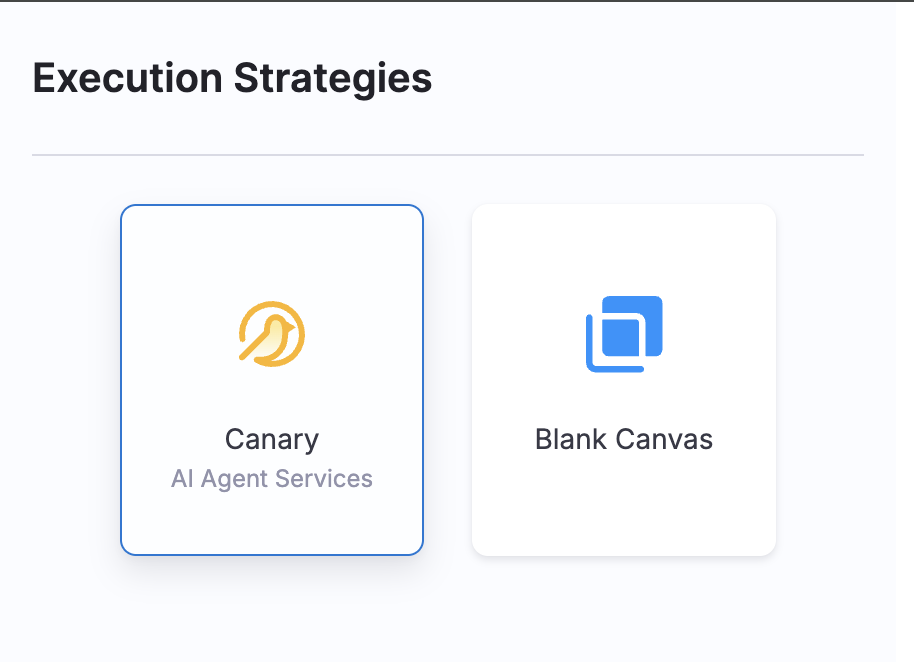
On the **Execution** tab of the stage, select the execution strategy. Select **Canary** to scaffold the deploy and traffic shift steps, or select **Blank Canvas** to build the execution from an empty step group.
Click to view full size
{% hint style="info" %}
Canary is the only execution strategy for agent deployments in this release. Support for more deployment strategies is planned.
{% endhint %}
***
### Default canary steps
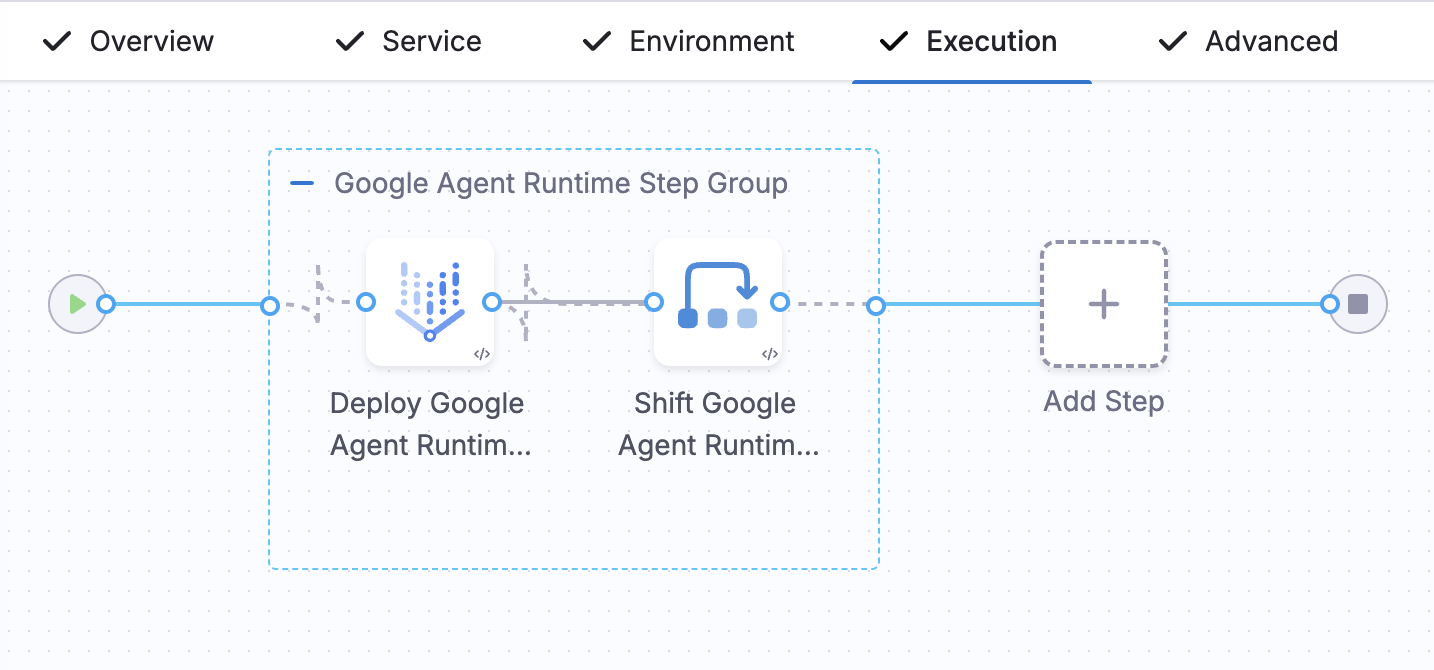
When you select the **Canary** strategy, Harness adds a step group with two steps: a deploy step and a single traffic shift step that routes 100 percent of traffic to the new revision. Harness also adds a rollback step group with the rollback step.
Click to view full size
### Deploy step
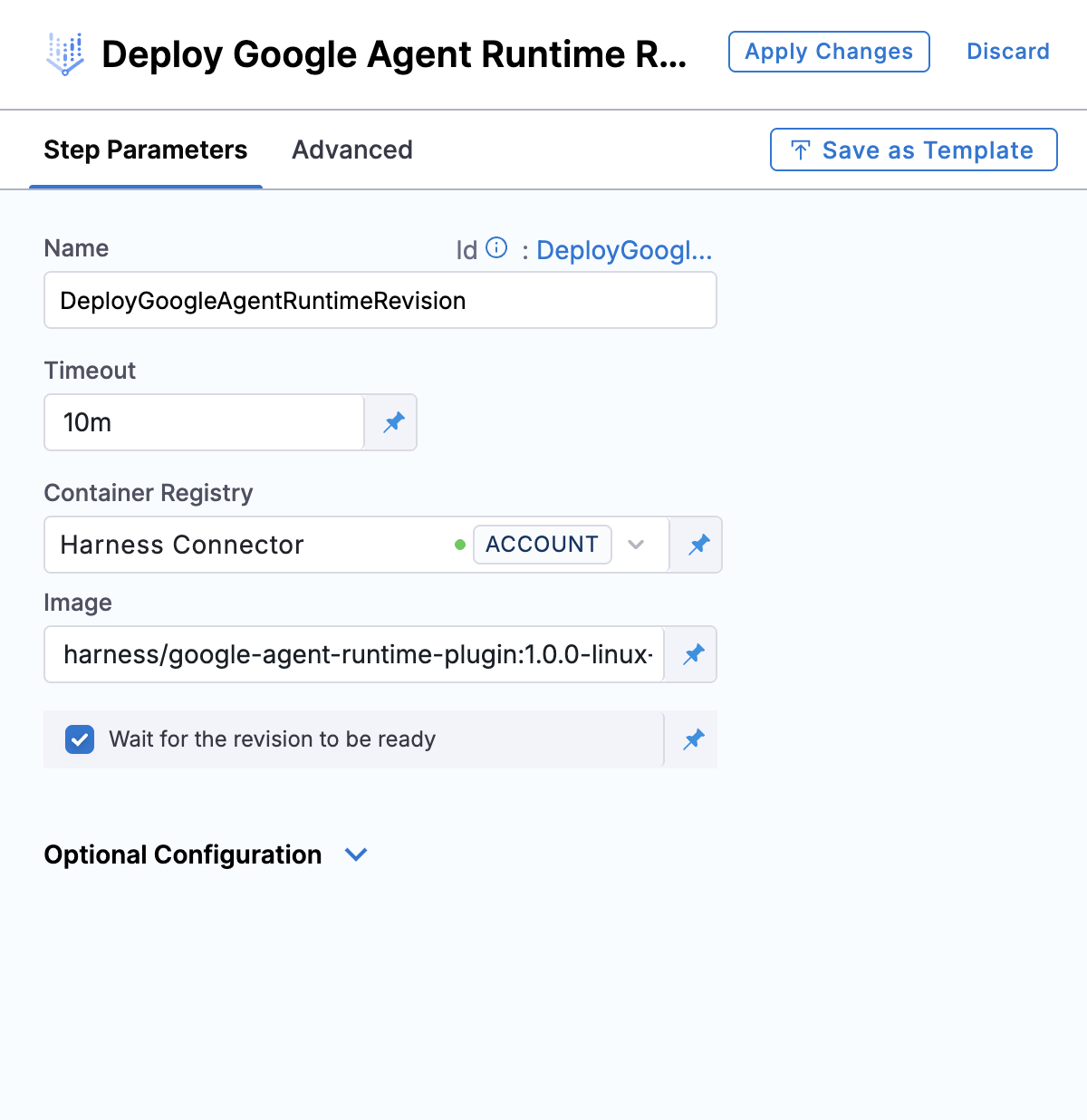
The deploy step creates a deployment for the agent on Google Agent Runtime. On the first deployment for an agent, it creates the deployment. When a deployment already exists, it creates a new revision under the same deployment. The step publishes the new revision id as output that the traffic shift steps read.
The step type is `DeployGoogleAgentRuntimeRevision`. Configure the following fields:
* **Container Registry:** A Harness connector for the registry that hosts the plugin image.
* **Image:** The deploy plugin image, `harness/google-agent-runtime-plugin:1.0.0-linux-amd64`.
* **Wait for the revision to be ready:** Enable this so the pipeline waits until the revision is ready before it continues.
Click to view full size
### Traffic shift step
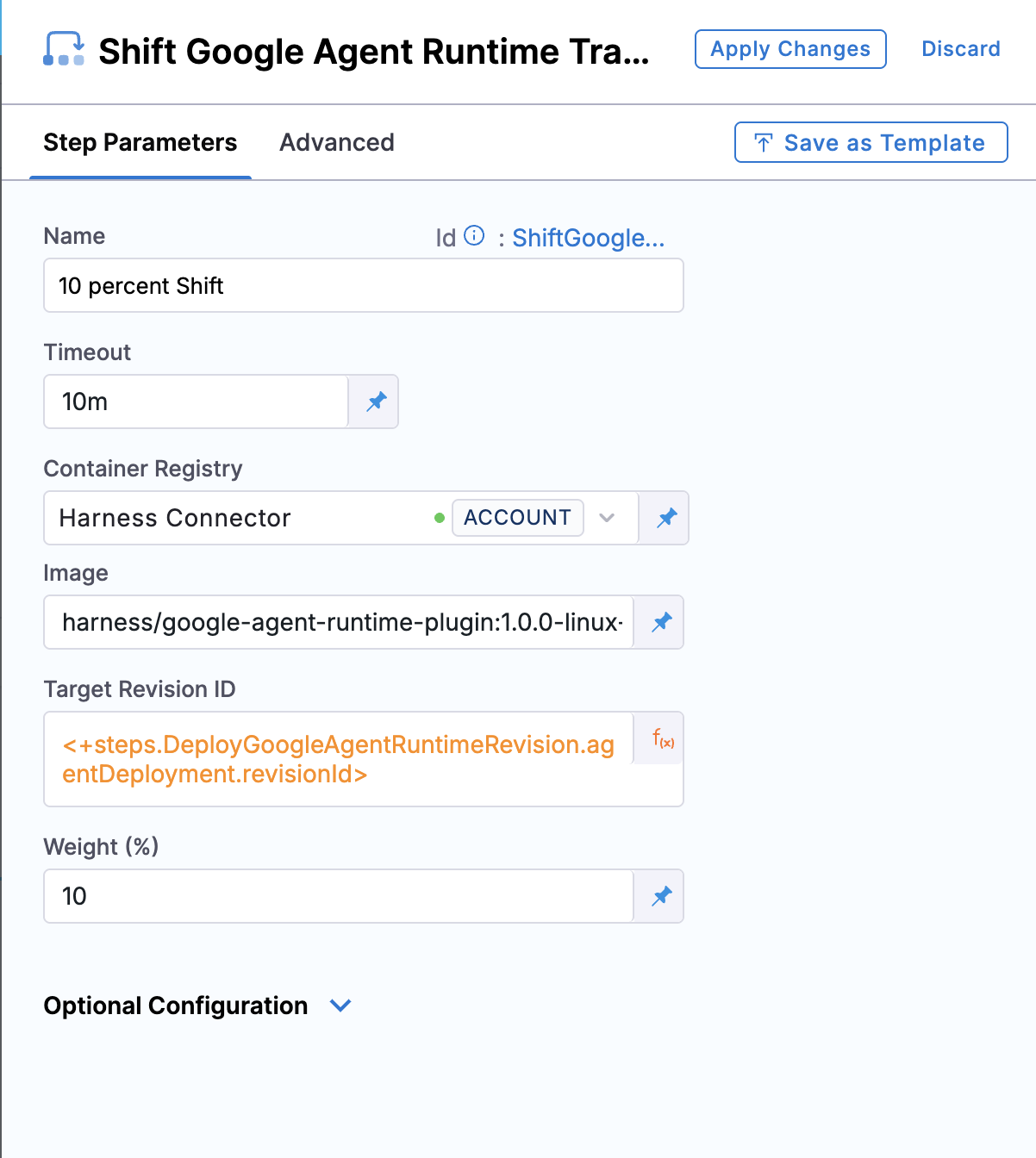
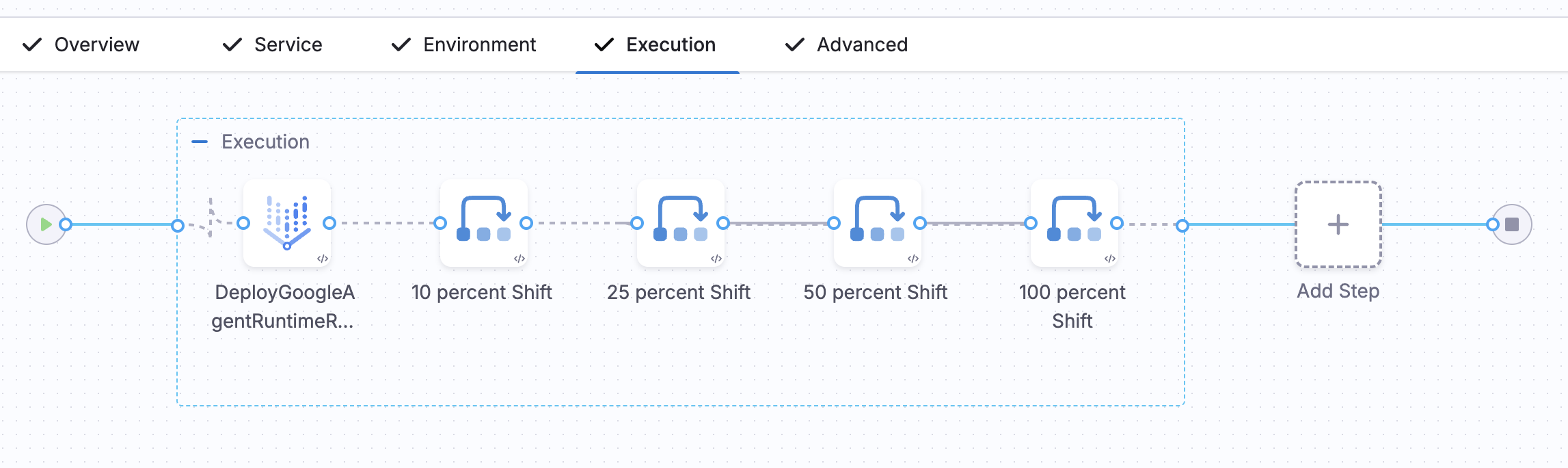
The traffic shift step routes a percentage of traffic to the revision produced by the deploy step. Add a step for each stage of the canary, for example 10 percent, 25 percent, 50 percent, and 100 percent.
The step type is `ShiftGoogleAgentRuntimeTraffic`. Configure the following fields:
* **Container Registry:** A Harness connector for the registry that hosts the plugin image.
* **Image:** The traffic shift plugin image, `harness/google-agent-runtime-plugin:1.0.0-linux-amd64`.
* **Target Revision ID:** The revision produced by the deploy step, `<+steps.DeployGoogleAgentRuntimeRevision.agentDeployment.revisionId>`.
* **Weight (%):** The percentage of traffic to route to the target revision for this shift.
Click to view full size
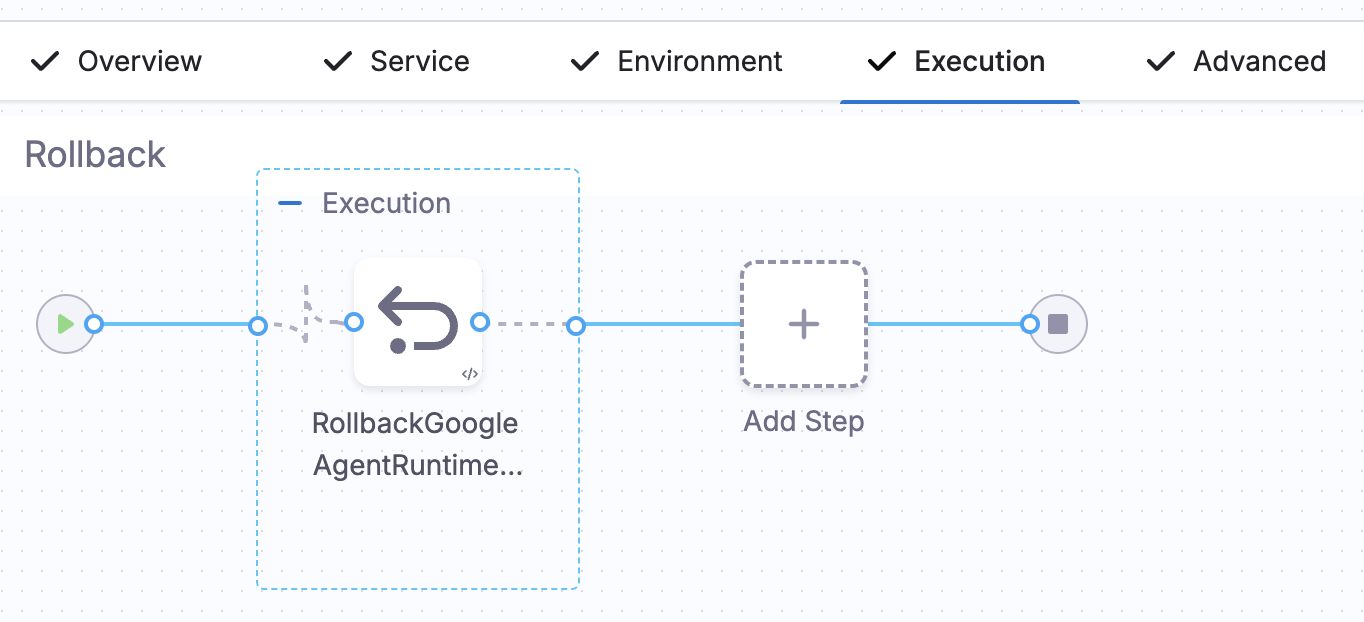
#### Rollback step
The rollback step reverts traffic to the previous revision. Harness adds it to the stage rollback steps so it runs when a deploy or traffic shift step fails.
The step type is `RollbackGoogleAgentRuntimeRevision` and the **Image** is `harness/google-agent-runtime-plugin:1.0.0-linux-amd64`.
Click to view full size
Default canary pipeline YAML
```yaml
pipeline:
projectIdentifier: Demo
orgIdentifier: default
tags: {}
stages:
- stage:
name: AI Agent
identifier: AI_Agent
description: ""
type: Deployment
spec:
deploymentType: AiAgent
service:
serviceRef: Google_Weather_Agent
environment:
environmentRef: Google_Agent_Platform
deployToAll: false
infrastructureDefinitions:
- identifier: GoogleAgentPlatform
execution:
steps:
- stepGroup:
steps:
- step:
type: DeployGoogleAgentRuntimeRevision
name: Deploy Google Agent Runtime Revision
identifier: Deploy_Google_Agent_Runtime_Revision
spec:
connectorRef: account.harness_image_registry
image: harness/google-agent-runtime-plugin:1.0.0-linux-amd64
imagePullPolicy: Always
waitReady: true
- step:
type: ShiftGoogleAgentRuntimeTraffic
name: Shift Google Agent Runtime Traffic
identifier: Shift_Google_Agent_Runtime_Traffic
spec:
connectorRef: account.harness_image_registry
image: harness/google-agent-runtime-plugin:1.0.0-linux-amd64
imagePullPolicy: Always
target:
revisionId: <+steps.Deploy_Google_Agent_Runtime_Revision.agentDeployment.revisionId>
weight: 100
name: Google Agent Runtime Step Group
identifier: Google_Agent_Runtime_Step_Group
sharedPaths:
- /var/run
- /var/lib/docker
stepGroupInfra:
type: KubernetesDirect
spec:
connectorRef: <+input>
namespace: default
rollbackSteps:
- stepGroup:
name: Google Agent Runtime Rollback Step Group
identifier: Google_Agent_Runtime_Rollback_Step_Group
steps:
- step:
type: RollbackGoogleAgentRuntimeRevision
name: Rollback Google Agent Runtime Revision
identifier: Rollback_Google_Agent_Runtime_Revision
spec:
connectorRef: account.harness_image_registry
image: harness/google-agent-runtime-plugin:1.0.0-linux-amd64
imagePullPolicy: Always
sharedPaths:
- /var/run
- /var/lib/docker
stepGroupInfra:
type: KubernetesDirect
spec:
connectorRef: <+input>
namespace: default
tags: {}
failureStrategies:
- onFailure:
errors:
- AllErrors
action:
type: StageRollback
identifier: Sample_Google_Agent_Runtime_Deployment
name: Sample Google Agent Runtime Deployment
```
***
### Add staged traffic shifts
To roll out more gradually, add more traffic shift steps between the deploy step and the final 100 percent shift. Each step routes an increasing percentage of traffic to the new revision, for example 10 percent, 25 percent, 50 percent, and 100 percent. Between the shifts, you can add smoke tests, evals, approval gates, or release gates to validate each stage before more traffic moves to the new revision.
Click to view full size
Staged canary pipeline YAML
```yaml
pipeline:
projectIdentifier: Demo
orgIdentifier: default
tags: {}
stages:
- stage:
name: Deploy
identifier: Deploy
description: ""
type: Deployment
spec:
deploymentType: AiAgent
service:
serviceRef: Google_Weather_Agent
environment:
environmentRef: Google_Agent_Platform
deployToAll: false
infrastructureDefinitions:
- identifier: GoogleAgentPlatform
execution:
steps:
- stepGroup:
name: Google Agent Runtime Step Group
identifier: Google_Agent_Runtime_Step_Group
steps:
- step:
type: DeployGoogleAgentRuntimeRevision
name: Deploy Google Agent Runtime Revision
identifier: Deploy_Google_Agent_Runtime_Revision
spec:
connectorRef: account.harness_image_registry
image: harness/google-agent-runtime-plugin:1.0.0-linux-amd64
imagePullPolicy: Always
waitReady: true
timeout: 10m
- step:
type: ShiftGoogleAgentRuntimeTraffic
name: 10 percent Shift
identifier: ShiftGoogleAgentRuntimeTraffic_10
spec:
connectorRef: account.harness_image_registry
image: harness/google-agent-runtime-plugin:1.0.0-linux-amd64
imagePullPolicy: Always
target:
revisionId: <+steps.Deploy_Google_Agent_Runtime_Revision.agentDeployment.revisionId>
weight: 10
timeout: 10m
- step:
type: ShiftGoogleAgentRuntimeTraffic
name: 25 percent Shift
identifier: ShiftGoogleAgentRuntimeTraffic_25
spec:
connectorRef: account.harness_image_registry
image: harness/google-agent-runtime-plugin:1.0.0-linux-amd64
imagePullPolicy: Always
target:
revisionId: <+steps.Deploy_Google_Agent_Runtime_Revision.agentDeployment.revisionId>
weight: 25
timeout: 10m
- step:
type: ShiftGoogleAgentRuntimeTraffic
name: 50 percent Shift
identifier: ShiftGoogleAgentRuntimeTraffic_50
spec:
connectorRef: account.harness_image_registry
image: harness/google-agent-runtime-plugin:1.0.0-linux-amd64
imagePullPolicy: Always
target:
revisionId: <+steps.Deploy_Google_Agent_Runtime_Revision.agentDeployment.revisionId>
weight: 50
timeout: 10m
- step:
type: ShiftGoogleAgentRuntimeTraffic
name: 100 percent Shift
identifier: ShiftGoogleAgentRuntimeTraffic_100
spec:
connectorRef: account.harness_image_registry
image: harness/google-agent-runtime-plugin:1.0.0-linux-amd64
imagePullPolicy: Always
target:
revisionId: <+steps.Deploy_Google_Agent_Runtime_Revision.agentDeployment.revisionId>
weight: 100
timeout: 10m
sharedPaths:
- /var/run
- /var/lib/docker
stepGroupInfra:
type: KubernetesDirect
spec:
connectorRef: <+input>
namespace: default
rollbackSteps:
- stepGroup:
name: Google Agent Runtime Rollback Step Group
identifier: Google_Agent_Runtime_Rollback_Step_Group
steps:
- step:
type: RollbackGoogleAgentRuntimeRevision
name: Rollback Google Agent Runtime Revision
identifier: Rollback_Google_Agent_Runtime_Revision
spec:
connectorRef: account.harness_image_registry
image: harness/google-agent-runtime-plugin:1.0.0-linux-amd64
imagePullPolicy: Always
sharedPaths:
- /var/run
- /var/lib/docker
stepGroupInfra:
type: KubernetesDirect
spec:
connectorRef: <+input>
namespace: default
tags: {}
failureStrategies:
- onFailure:
errors:
- AllErrors
action:
type: StageRollback
identifier: Sample_Google_Agent_Runtime_Staged_Canary
name: Sample Google Agent Runtime Staged Canary
```
***
### Run and monitor the deployment
Run the pipeline to deploy the agent. After the pipeline runs, open the agent service to review the deployment. The **Summary** tab lists every deployment that references the agent service, with its status and start time, and the **Configuration** tab shows the platform configuration, which you can edit.
Because the agent is a Harness deployment, approvals, OPA policies, and RBAC apply the same way they do for any other stage.
***
### Next steps
You have deployed an agent service to Google Agent Runtime with a canary strategy. You can now add approvals and policies to the stage, or configure additional environments.
* [Step reference](/continuous-delivery/use-continuous-delivery/ai-agents-deployment/google-agent-runtime/step-reference/deploy-step.md): Review the deploy and traffic-shift step parameters in detail.
* [Deploy to AWS Agent Core](/continuous-delivery/use-continuous-delivery/ai-agents-deployment/aws-agent-core/overview.md): Deploy an agent to Amazon Bedrock AgentCore instead.
{% @harness-feedback/feedback %}