> For the complete documentation index, see [llms.txt](https://developer.harness.io/llms.txt). Markdown versions of documentation pages are available by appending `.md` to page URLs; this page is available as [Markdown](https://developer.harness.io/continuous-delivery/use-gitops/application/harness-expressions-in-gitops-applications.md).
# Use Harness expressions in GitOps manifests
Inject Harness service variables, environment variables, and secrets into Argo CD manifests at manifest generation time.
Use the Harness GitOps plugin to resolve Harness expressions in Kubernetes manifests during Argo CD's manifest generation phase. This lets you inject dynamic values from Harness services and environments into your manifests before Argo CD applies them to the cluster.
{% hint style="warning" %}
**Application detection**
The Harness plugin uses an explicit, per-application connection to determine which applications it processes. The plugin does not automatically claim an application based on repository contents alone. Each application must specify one of the following:
* `spec.source.plugin.name: argocd-harness-plugin` on the Argo CD Application.
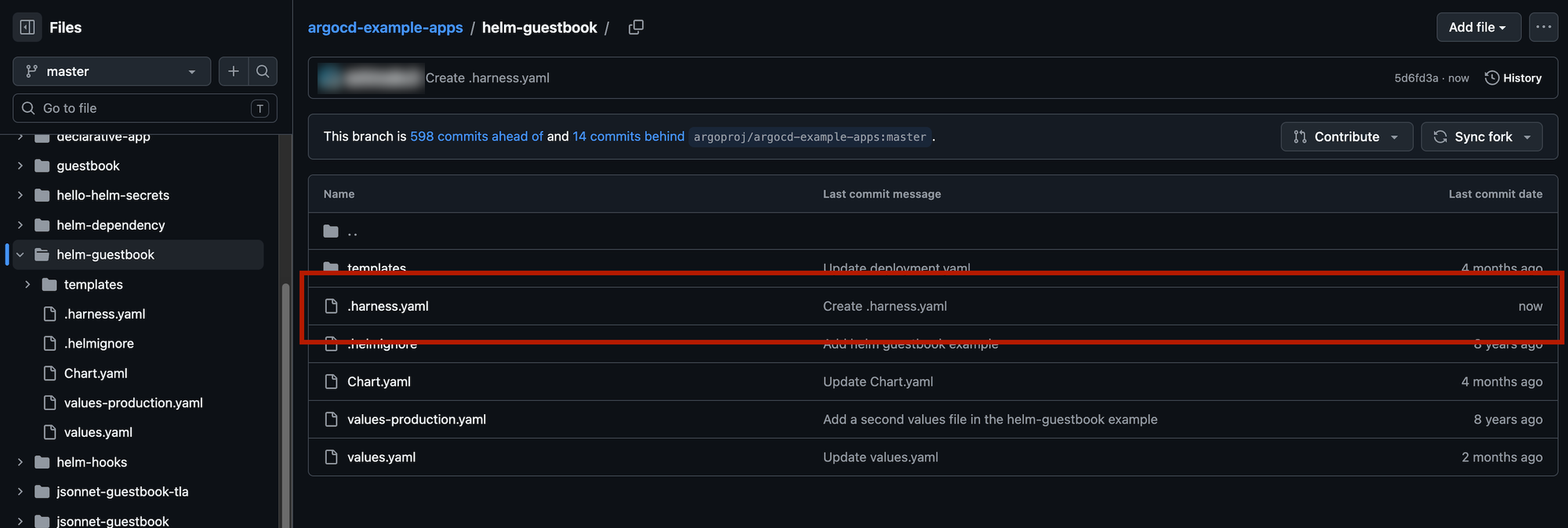
* `.harness.yaml` in the application's source directory.
Without an explicit connection, Harness expressions remain unresolved in generated manifests.
Go to [Connect an application to the plugin](#connect-an-application-to-the-plugin) to configure the connection.
{% endhint %}
## What you will learn from this topic
* How to [configure the plugin](#configure-the-harness-argo-cd-plugin) on new or existing GitOps agents
* How to [connect an application to the plugin](#connect-an-application-to-the-plugin) so expressions resolve
* How the plugin [detects your manifest tool](#manifest-tool-selection) (Helm, Kustomize, or plain manifests)
* How to [use expressions](#expression-reference) for service variables, environment variables, and secrets
* How to [override variables](#override-priority) per environment
* How to [troubleshoot](#troubleshooting) common expression resolution issues
{% hint style="info" %}
**Secrets and security**
This topic covers expressions and tool detection. Go to [Secret injection in GitOps applications](/continuous-delivery/use-gitops/security/secret-injection-harness-plugin.md) to review Vault and Secret Manager integration and the security model.
{% endhint %}
***
## Before you begin
Before using Harness expressions in GitOps manifests, ensure you have:
* **Harness service**: A GitOps service configured with variables. Go to [GitOps services](/continuous-delivery/use-gitops/gitops-entities/service/service.md) to create and configure services.
* **Harness environment**: An environment configured with variables and linked to your service. Go to [Environments overview](/continuous-delivery/use-continuous-delivery/cd-building-blocks/environments/environment-overview.md) to configure environments and variables.
***
## Configure the Harness Argo CD plugin
Do this once when setting up the agent. If the plugin is already enabled on your agent, go to [Connect an application to the plugin](#connect-an-application-to-the-plugin) to connect your application.
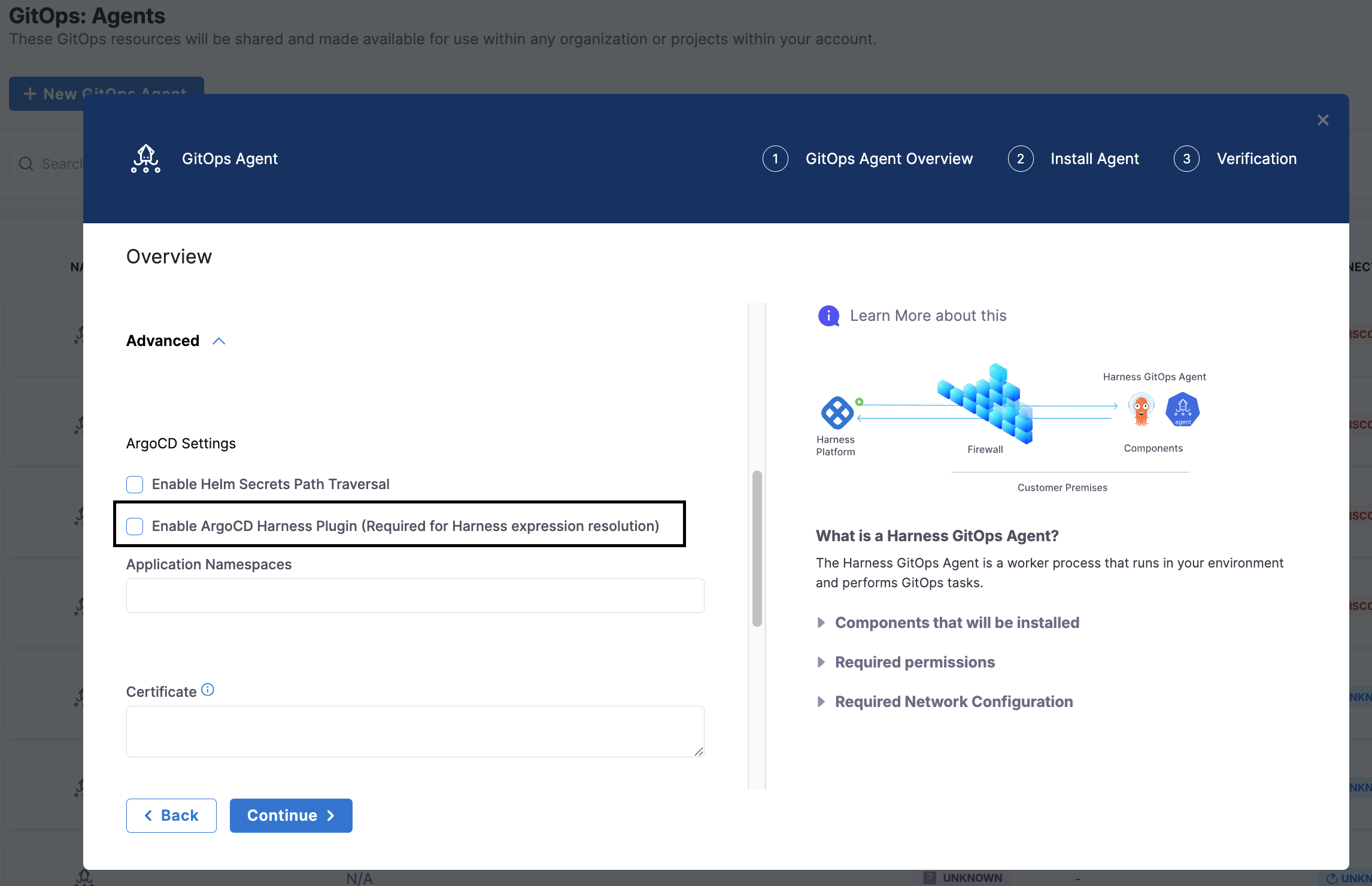
**For new Agent installations:** Select the **Enable ArgoCD Harness Plugin (Required for Harness expression resolution)** checkbox during GitOps agent installation to use this feature. No additional configuration is needed.
**For existing Agent installations (BYOA or Harness-installed Argo):** The **Enable ArgoCD Harness Plugin (Required for Harness expression resolution)** checkbox cannot be changed after the initial installation. You must configure the Harness Argo CD plugin manually. Go to [Enable the plugin on an existing agent or BYOA](#enable-the-plugin-on-an-existing-agent-or-byoa) to configure the plugin manually.
Once enabled, connect each Application to the plugin and use expressions in your manifests:
**Step 1.** Connect the Application to the plugin
Set the plugin name on the Application:
```yaml
spec:
source:
repoURL: https://github.com/your-org/your-repo
targetRevision: HEAD
path: manifests/
plugin:
name: argocd-harness-plugin
```
Or add `.harness.yaml` to the Application's source directory. Go to [Connect an application to the plugin](#connect-an-application-to-the-plugin) to review both methods.
**Step 2.** Use expressions in your manifests
```yaml
spec:
replicas: <+serviceVariables.replicas>
template:
spec:
containers:
- name: app
image: myapp:<+serviceVariables.imageTag>
env:
- name: LOG_LEVEL
value: <+env.variables.logLevel>
- name: ENV_NAME
value: <+env.name>
```
Expressions resolve at manifest generation time. Sync (or let auto-sync trigger) and the deployed manifest contains the resolved values.
### Limitations
The following limitations apply when you use the Harness plugin:
| Limitation | Details |
| ----------------------------------------- | ----------------------------------------------------------------------------------------------------------------------------------------- |
| Kustomize `secretGenerator` | Secret resolution inside `secretGenerator`-produced `Secret` objects is unverified; use plain `Secret` manifests instead until confirmed. |
| Application source type shows as `Plugin` | Argo CD shows source type as **Plugin** instead of Helm/Directory. Path listing in UI will not work; specify paths manually. |
| `HELM_ARGS` | Shell-injection risk; go to [`HELM_ARGS` environment variable](#helmargs-environment-variable) for the warning. |
***
## Connect an application to the plugin
{% hint style="warning" %}
**Application routing is required**
The plugin processes an application's manifests only when Argo CD is configured to route the application to the Harness plugin. If the application is not routed to the plugin, Harness expressions remain unresolved and appear literally in the generated manifests.
{% endhint %}
There are two ways to connect an Application to the plugin. Use either method:
| Method | How |
| ------------------------- | ----------------------------------------------------------------------- |
| **Explicit plugin name** | Set `spec.source.plugin.name: argocd-harness-plugin` on the Application |
| **File-based activation** | Add `.harness.yaml` to the Application's source directory |
**Explicit plugin name:**
```yaml
spec:
source:
repoURL: https://github.com/your-org/your-repo
targetRevision: HEAD
path: manifests/
plugin:
name: argocd-harness-plugin
```
**File-based activation**: commit `.harness.yaml` to the application's source directory:
```yaml
# An empty file is valid.
```
In the example below, the Argo CD Application's `spec.source.path` is `helm-guestbook`. The `.harness.yaml` file is committed inside that directory, alongside `Chart.yaml` and `values.yaml`.
{% hint style="warning" %}
**`.harness.yaml` must be inside `spec.source.path`**
Argo CD checks for the file inside the Application's source path. If your Application's `path` is `charts/myapp`, the file must be at `charts/myapp/.harness.yaml`. A file at the repo root will not be found.
{% endhint %}
**Custom activation conditions (optional, advanced)**
Not required for most setups. Use this only if neither the explicit plugin name nor the `.harness.yaml` marker fits your workflow, for example, if you want to use a different filename, or check for multiple possible markers.
The plugin checks for `.harness.yaml` using a shell command in the ConfigManagementPlugin spec. You can replace that command with any shell expression that exits `0` for applications the plugin should process and non-zero for those it should not. The command runs inside the Application's source directory (`spec.source.path`).
To customize, edit the `discover.find.command` in the plugin ConfigMap directly. Go to [Enable the plugin on an existing agent or BYOA](#enable-the-plugin-on-an-existing-agent-or-byoa) to review the ConfigMap structure.
```yaml
discover:
find:
command:
- /bin/sh
- -c
- "test -f .harness.yaml || test -f .harness-plugin" # activate on either file
```
Or check for a specific key inside the file:
```yaml
- "grep -q '^harness:' .harness.yaml 2>/dev/null"
```
The built-in default (`test -f .harness.yaml`) is sufficient for almost all cases. Custom conditions are a BYOA or Helm-managed install concern; Harness-provisioned agents manage this ConfigMap automatically.
***
## Manifest tool selection
No configuration needed for most applications. The plugin detects Helm, Kustomize, or plain manifests automatically. Read this section only if auto-detection is picking the wrong tool for your application.
**Tool selection at generation time**
Once the plugin is processing an Application, it auto-detects the manifest tool by inspecting the source directory. For most applications this requires no configuration. The following table lists the detection rules:
| Condition | Tool used |
| -------------------------------------------------------------------- | ------------------------ |
| `kustomization.yaml`, `kustomization.yml`, or `Kustomization` exists | `kustomize build .` |
| `Chart.yaml` or `values.yaml` exists | `helm template` |
| None of the above | Plain manifests (native) |
Expressions are resolved on the tool's **output**, after Helm or Kustomize has already rendered the manifests.
If auto-detection picks the wrong tool, you can override it. Go to [Overriding the manifest tool](#overriding-the-manifest-tool) to force a specific tool.
### Plain manifests
No `Chart.yaml` or `kustomization.yaml`: just raw manifests. No extra configuration needed:
```yaml
apiVersion: v1
kind: ConfigMap
metadata:
name: app-config
data:
log-level: <+env.variables.logLevel>
cluster: <+env.variables.clusterName>
```
### Helm
Plugin runs `helm template` and resolves expressions in the output. Helm subchart dependencies (`helm dependency build`) run automatically; no need to vendor `charts/`:
```yaml
replicaCount: <+serviceVariables.replicas>
image:
tag: <+serviceVariables.imageTag>
```
### Kustomize
Plugin runs `kustomize build .` and resolves expressions in the output. Expressions can appear in any resource Kustomize renders, including patches:
```yaml
apiVersion: apps/v1
kind: Deployment
metadata:
name: myapp
spec:
replicas: <+serviceVariables.replicas>
```
{% hint style="warning" %}
**Kustomize and secretGenerator**
Expression resolution for `kind: Secret` objects produced by Kustomize's `secretGenerator` is not yet verified. Use plain `Secret` manifests (not `secretGenerator`) if you need secret injection with Kustomize.
{% endhint %}
**Overriding the manifest tool**
If auto-detection picks the wrong tool, add a `tool:` key to `.harness.yaml`:
```yaml
tool: kustomize # one of: helm, kustomize, native
```
***
## Expression reference
All expressions resolve at **manifest generation time** (pre-deployment, not runtime).
### Expression types
The following expressions are available in GitOps manifests:
| Expression | Source | Example |
| ---------------------------------------- | ---------------------------- | -------------------------------------- |
| `<+serviceVariables.name>` | Service-level variables | `<+serviceVariables.replicas>` |
| `<+env.variables.name>` | Environment-level variables | `<+env.variables.logLevel>` |
| `<+env.name>` | Environment display name | `production` |
| `<+env.identifier>` | Environment identifier | `prod` |
| `<+env.type>` | Environment type | `Production` or `PreProduction` |
| `<+env.description>` | Environment description | |
| `<+variable.account.name>` | Account-scope fixed variable | `<+variable.account.companyId>` |
| `<+variable.org.name>` | Org-scope fixed variable | `<+variable.org.defaultRegion>` |
| `<+variable.name>` | Project-scope fixed variable | `<+variable.projectCode>` |
| `<+secrets.getValue("ref")>` | Secret (direct reference) | `<+secrets.getValue("vault_secret")>` |
| `<+serviceVariables.name>` (Secret type) | Secret via service variable | resolves to `<+secrets.getValue(...)>` |
### Define variables
* **Service variables**: **Deployments** -> **Services** -> select the service -> **Configuration** -> **Variables**
* **Environment variables**: **Deployments** -> **Environments** -> select the environment -> **Configuration** -> **Variables**
* **Fixed variables**: Account, Org, or Project **Settings** -> **Variables**
### Override priority
When the same variable name exists at multiple levels, the highest-priority override wins:
```
ENV_SERVICE > Service (base) > ENV_GLOBAL > Environment (base)
```
The following table describes each override type:
| Override type | How to configure | Scope |
| ---------------- | ---------------------------------------------------------- | ------------------------------------------------------------------------ |
| **ENV\_SERVICE** | **Environment** -> **Service Overrides** -> select service | Overrides a service variable for a specific service and environment pair |
| **ENV\_GLOBAL** | **Environment** -> **Configuration** -> **Variables** | Overrides an environment variable for all services in that environment |
### Secret variables
Variables defined as type **Secret** in Harness go through two-stage resolution:
1. **Manifest generation**: `<+serviceVariables.dbPassword>` resolves to `<+secrets.getValue('account.prodDbPassword')>`.
2. **Deployment time**: The actual secret value is injected into the cluster.
```yaml
apiVersion: v1
kind: Secret
metadata:
name: app-secrets
type: Opaque
stringData:
db-password: <+serviceVariables.dbPassword>
api-key: <+serviceVariables.apiKey>
```
{% hint style="info" %}
Secret expressions (`<+secrets.getValue()>`) are only resolved when they appear inside a `kind: Secret` resource.
{% endhint %}
### Complete example
```yaml
apiVersion: apps/v1
kind: Deployment
metadata:
name: myapp
namespace: <+env.variables.namespace>
labels:
environment: <+env.type>
spec:
replicas: <+serviceVariables.replicas>
template:
spec:
containers:
- name: myapp
image: myapp:<+serviceVariables.imageTag>
env:
- name: LOG_LEVEL
value: <+env.variables.logLevel>
- name: REGION
value: <+serviceVariables.region>
- name: ENV_NAME
value: <+env.name>
resources:
limits:
memory: <+serviceVariables.memoryLimit>
cpu: <+serviceVariables.cpuLimit>
```
### GitOps expressions vs pipeline expressions
GitOps expressions are a subset of Harness expressions: they only have access to service and environment context, not pipeline runtime context.
{% hint style="info" %}
**Exception for PR pipelines**
When syncing manifests within PR Pipelines (for example, using the GitOps Sync step), GitOps expressions can access pipeline runtime context. This allows you to reference pipeline variables, execution details, and other pipeline-level expressions during PR Pipeline execution.
{% endhint %}
The following table compares GitOps expressions and pipeline expressions:
| | GitOps expressions | Pipeline expressions |
| ----------------- | ------------------------------------------------ | -------------------------------------------------------- |
| **When resolved** | Manifest generation (pre-deploy) | Pipeline runtime |
| **Context** | Service + environment + metadata | Full pipeline (`artifact.*`, `infra.*`, `stage.*`, etc.) |
| **Not available** | `pipeline.*`, `stage.*`, `artifact.*`, `infra.*` | |
Use GitOps expressions when the value is known at manifest generation time and tied to service or environment config. Use pipeline expressions for artifact versions, build numbers, or step outputs.
***
## Enable the plugin on an existing agent or BYOA
The **Enable ArgoCD Harness Plugin** checkbox can only be set at initial Agent installation. Use one of these patch paths if your agent is already installed.
### Normal GitOps Agent installation
The Helm chart always deploys the plugin sidecar (`argocd-harness-plugin`) as an extra container on the `argocd-repo-server`. There is no values flag to enable it.
1. Run `helm upgrade`. The plugin sidecar is included in the chart by default, so no values flag is needed to enable it:
```bash
helm upgrade gitops-agent/gitops-helm \
--values values.yaml \
--namespace
```
2. Verify the rollout:
```bash
kubectl rollout status deployment/argocd-repo-server -n
```
3. Verify the plugin sidecar is running:
```bash
kubectl exec -n \
-c argocd-harness-plugin -- argocd-harness-plugin version
```
### BYOA (Bring Your Own Argo CD)
1. Apply the plugin ConfigMap:
```bash
kubectl apply -n -f - <<'EOF'
apiVersion: v1
kind: ConfigMap
metadata:
name: argocd-harness-plugin
namespace:
data:
harness.yaml: |
---
apiVersion: argoproj.io/v1alpha1
kind: ConfigManagementPlugin
metadata:
name: argocd-harness-plugin
spec:
allowConcurrency: true
discover:
find:
command:
- /bin/sh
- -c
- "test -f .harness.yaml"
init:
command:
- /bin/sh
- -c
- |
set -o pipefail
if [ -f "Chart.yaml" ]; then
helm dependency build > /dev/null 2>&1 || true
fi
generate:
command:
- /bin/sh
- -c
- |
set -o pipefail
if [ -f ".harness.yaml" ] && grep -q '^tool:' ".harness.yaml"; then
TOOL=$(grep '^tool:' ".harness.yaml" | head -1 | cut -d: -f2 | tr -d ' "')
else
TOOL=""
fi
if [ "$TOOL" = "kustomize" ] || { [ -z "$TOOL" ] && { [ -f "kustomization.yaml" ] || [ -f "kustomization.yml" ] || [ -f "Kustomization" ]; }; }; then
kustomize build . | argocd-harness-plugin generate -
elif [ "$TOOL" = "helm" ] || { [ -z "$TOOL" ] && { [ -f "Chart.yaml" ] || [ -f "values.yaml" ]; }; }; then
helm template $ARGOCD_APP_NAME -n $ARGOCD_APP_NAMESPACE ${ARGOCD_ENV_HELM_ARGS} --include-crds . \
| argocd-harness-plugin generate -
else
argocd-harness-plugin generate .
fi
lockRepo: false
EOF
```
2. Patch the `argocd-repo-server` Deployment to add the sidecar (skip if already present):
```bash
kubectl patch deployment argocd-repo-server -n --type=json -p='[
{"op": "add", "path": "/spec/template/spec/containers/-", "value": {
"name": "argocd-harness-plugin",
"command": ["/var/run/argocd/argocd-cmp-server"],
"image": "harness/gitops-agent-installer-helper:v0.3.0",
"imagePullPolicy": "IfNotPresent",
"securityContext": {"runAsUser": 999, "runAsGroup": 999, "capabilities": {"drop": ["NET_RAW"]}},
"volumeMounts": [
{"name": "var-files", "mountPath": "/var/run/argocd"},
{"name": "plugins", "mountPath": "/home/argocd/cmp-server/plugins"},
{"name": "tmp", "mountPath": "/tmp"},
{"name": "argocd-harness-plugin", "mountPath": "/home/argocd/cmp-server/config/plugin.yaml", "subPath": "harness.yaml"}
]
}},
{"op": "add", "path": "/spec/template/spec/volumes/-", "value": {
"name": "argocd-harness-plugin",
"configMap": {"name": "argocd-harness-plugin"}
}}
]'
```
The image value above has no tag. Add the current tag from the charts/values.yaml file in the gitops-helm chart, which is the authoritative source (currently v0.3.0 at time of writing).
3. Verify:
```bash
kubectl rollout status deployment/argocd-repo-server -n
kubectl exec -n \
-c argocd-harness-plugin -- kustomize version
```
{% hint style="info" %}
**Upgrade from an older plugin install**
If you already have an `argocd-harness-plugin` ConfigMap from a previous install, re-applying the ConfigMap in step 1 is sufficient; you do not need to re-patch the Deployment.
{% endhint %}
### `HELM_ARGS` environment variable
The plugin passes `${ARGOCD_ENV_HELM_ARGS}` directly to `helm template`:
```yaml
spec:
source:
plugin:
name: argocd-harness-plugin
env:
- name: HELM_ARGS
value: -f values-dev.yaml --set replicaCount=3
```
{% hint style="warning" %}
**Shell injection risk**
`HELM_ARGS` is passed to `helm template` without escaping. Only use it when all users with `Application` edit access are trusted. Prefer chart-native `values.yaml` overrides in shared or multi-tenant clusters.
{% endhint %}
***
## Troubleshooting Expression appears literally in the deployed manifest
The expression was not resolved: it shows as `<+serviceVariables.replicas>` instead of `3`.
**Try first:** Hard-refresh the Argo CD application to invalidate the manifest cache.
**Then check:**
1. **Variable exists?** Verify the variable name and scope in Harness UI (exact match, case-sensitive).
2. **Plugin enabled?** Check that `spec.source.plugin.name: argocd-harness-plugin` is set on the Application.
3. **Typo?** Check for extra spaces or incorrect syntax; expressions are `<+serviceVariables.name>` not `<+ serviceVariables.name>`.
Kustomize: "command not found"
```
kustomize: command not found
```
The sidecar image predates Kustomize support. Ensure the sidecar image is up to date by checking the current tag in the gitops-helm chart values. Go to [Enable the plugin on an existing agent or BYOA](#enable-the-plugin-on-an-existing-agent-or-byoa) to update the agent.
Override not taking effect
1. **Wrong scope:** Service variables must be overridden at ENV\_SERVICE level; environment variables at ENV\_GLOBAL. You cannot override a service variable using ENV\_GLOBAL.
2. **Not saved?** Verify the override is saved and the correct service+environment combination is selected.
3. **Name mismatch?** Override variable name must match exactly (case-sensitive).
Numeric value rendered as string
Define the variable as type **Number** (not String) in Harness:
```yaml
variables:
- name: replicas
type: Number # not String
value: 3
```
Harness expressions stopped resolving after an agent upgrade or recreation
**Symptom:** An application that previously had Harness expressions resolved in its manifests no longer resolves them after you upgraded or recreated the agent. The expressions appear literally in the deployed manifests (for example, `<+serviceVariables.replicas>` instead of `3`).
**Cause:** If the application did not have `spec.source.plugin.name: argocd-harness-plugin` set, expression resolution depends on `.harness.yaml` being present in the application's source directory. If that file is absent, the Harness plugin does not process the application's manifests.
**Fix:**
Choose one of the following options:
* Set `spec.source.plugin.name: argocd-harness-plugin` on the Application. Argo CD routes the Application directly to the plugin regardless of what files are in the repo.
* Commit `.harness.yaml` to the application's source path. The file must be inside `spec.source.path`, not the repo root. Go to [Connect an application to the plugin](#connect-an-application-to-the-plugin) to review the setup steps.
Secret not resolving
1. Variable must be type **Secret** (not String) to trigger two-stage resolution.
2. Secret must exist in Harness Secrets Manager before being referenced.
3. Check secret reference format: `account.secretName` or `org.secretName`.
***
## Next steps
* [Secret injection in GitOps applications](/continuous-delivery/use-gitops/security/secret-injection-harness-plugin.md): Vault, Harness Secret Manager, and security model
* [Manage GitOps applications](/continuous-delivery/use-gitops/application/manage-gitops-applications.md): Create, sync, and manage ArgoCD applications in Harness
* [Harness GitOps basics](/continuous-delivery/use-gitops/get-started/harness-git-ops-basics.md): Core concepts and architecture of Harness GitOps
{% @harness-feedback/feedback %}