> For the complete documentation index, see [llms.txt](https://developer.harness.io/llms.txt). Markdown versions of documentation pages are available by appending `.md` to page URLs; this page is available as [Markdown](https://developer.harness.io/continuous-delivery/use-gitops/pr-pipelines/pr-pipelines-basics.md).
# GitOps PR pipelines
Learn how Harness GitOps PR pipelines automate Git-based deployments through pull requests, from trigger to cluster sync.
A Harness GitOps PR pipeline automates the full lifecycle of a Git-based deployment. Instead of applying changes directly to a cluster, the pipeline commits configuration updates to a Git repository, raises a pull request for review, and lets ArgoCD reconcile the desired state once the PR is merged. This keeps Git as the single source of truth while giving you pipeline-level orchestration, approval gates, and audit trails.
### What is a PR pipeline?
A PR pipeline connects your CI/CD workflow to GitOps by turning every deployment into a traceable Git change. You can choose between two flow patterns depending on how you want PR reviews and approvals to work.
**Standard flow (separate Merge PR step):**
```
Pipeline Trigger
│
▼
Update Release Repo ── commits config changes & raises a PR
│
▼
PR Created in Git
│
▼
Review / Approval ──── manual or automated
│
▼
Merge PR ───────────── pipeline merges the approved PR
│
▼
ArgoCD Detects Change
│
▼
GitOps Sync ────────── forces an immediate sync (optional)
│
▼
Application Updated in Cluster
```
**PR-based promotion flow (wait for PR merge):**
```
Pipeline Trigger
│
▼
Update Release Repo ── commits config changes, raises a PR,
│ and waits for external merge
▼
PR Created in Git ──── reviewers notified via Git provider
│
▼
PR Reviewed & Merged ─ via Git provider (GitHub, GitLab, etc.)
│
▼
Pipeline Resumes
│
▼
ArgoCD Detects Change
│
▼
GitOps Sync ────────── forces an immediate sync (optional)
│
▼
Application Updated in Cluster
```
In the PR-based promotion flow, the pipeline pauses at the Update Release Repo step until the PR is merged through your Git provider's native review process. This removes the need for both a separate Merge PR step and an Approval step in the pipeline, because the PR review itself acts as the approval gate.
Each box in the flow maps to a concrete pipeline step you can configure in the Harness UI.
### Prerequisites
Before you create a PR pipeline, make sure the following are in place:
* **GitOps service with a Release Repo manifest:** The service must have at least a Release Repo manifest that points to the config file the pipeline will update (e.g. `values.yaml`, `config.json`). See [Create a GitOps service](/continuous-delivery/use-gitops/gitops-entities/service/service.md).
* **Harness environment and cluster:** An environment linked to a GitOps cluster managed by your GitOps agent. See [Create GitOps environments](/continuous-delivery/use-gitops/gitops-entities/environment.md).
* **Git connector with write access:** A Harness Git connector that has permission to create branches and pull requests in your target repository.
* **ArgoCD application synced to a base state:** The GitOps application should already be synced so the pipeline has a known-good starting point.
### Execution Strategies panel
When you open the **Execution** tab for a new GitOps CD stage for the first time, Harness shows an **Execution Strategies** panel so you can add a starting set of steps instead of building the stage from an empty canvas. The panel appears only once, before the stage has any steps. You cannot reopen it after you close it or after you select a strategy.

The panel offers three strategies:
* **Single App:** Deploy a single GitOps Application.
* **App Set:** Deploy applications generated by an ApplicationSet.
* **Rollout:** Deploy through Argo Rollouts progressive delivery.
Every strategy also has a **Sync in the Pipeline** checkbox, selected by default. Clear the checkbox if the target application already has auto sync enabled in ArgoCD, so the pipeline does not need to trigger a sync itself. Selecting a strategy and a checkbox state, then selecting **Use Strategy**, adds the following steps to the stage:
| Strategy | Sync in the Pipeline checkbox | Steps added |
| ---------- | ----------------------------- | ------------------------------------------------------------- |
| Single App | Selected (default) | Update Release Repo, Merge PR, GitOps Sync |
| Single App | Cleared | Update Release Repo, Merge PR |
| App Set | Selected (default) | Update Release Repo, Merge PR, Fetch Linked Apps, GitOps Sync |
| App Set | Cleared | Update Release Repo, Merge PR, Fetch Linked Apps |
| Rollout | Selected (default) | Update Release Repo, Merge PR, GitOps Sync, GitOps Rollout |
| Rollout | Cleared | Update Release Repo, Merge PR, GitOps Rollout |
Go to [GitOps pipeline steps](#gitops-pipeline-steps) to configure each of these steps once they are added.
If you do not want to start from a strategy, close the panel. The stage opens with a blank canvas, and you add steps yourself using **+ Add Step**.
### GitOps pipeline steps
Harness provides purpose-built steps for GitOps pipelines. The table below summarizes every available step, what it does, and which service manifest it depends on.
| Pipeline step | Purpose | Manifest required |
| ------------------------------------------------- | ----------------------------------------------------------------------------------------------------------------------------------------------- | ----------------------------------------------------- |
| [Update Release Repo](#update-release-repo) | Commits config changes (image tag, Helm values, etc.) to the release repo and raises a PR. Optionally waits for the PR to be merged externally. | Release Repo manifest |
| [Merge PR](#merge-pr) | Merges the PR created by Update Release Repo into the target branch | None |
| [Fetch Linked Apps](#fetch-linked-apps) | Discovers GitOps applications linked to the service and environment (ApplicationSet workflows only) | Deployment Repo manifest or ApplicationSet references |
| [GitOps Sync](#gitops-sync) | Triggers a hard sync of an ArgoCD application to apply the latest Git state | None |
| [Update GitOps App](#update-gitops-app) | Updates values files, Helm overrides, or target revision directly on the application | None |
| [GitOps Rollback](#gitops-rollback) | Rolls an Argo CD application back to a previous deployment revision | None |
| [GitOps Get App Details](#gitops-get-app-details) | Returns real-time application status as JSON for use in subsequent steps | None |
| [Revert PR](#revert-pr) | Reverts a previously merged PR - used in rollback scenarios | None |
| [GitOps Rollout](#gitops-rollout) | Controls Argo Rollouts progressive delivery (pause, resume, abort) | None |
***
#### Update Release Repo
Fetches config files from the release repo, applies variable changes, commits to a new branch, and creates a PR. If the Release Repo Manifest's File Path resolves to more than one file, the step applies the variable changes to every matched file and creates a single PR for all of them. Go to [Match multiple files with a path pattern](/continuous-delivery/use-gitops/gitops-entities/service/service.md#match-multiple-files-with-a-path-pattern) to configure this.
| Parameter | Type | Required | Description |
| ---------------------------------------------------------------- | --------- | ----------------------------------------- | ----------------------------------------------------------------------------------------------------------------------------------------------------------------------------------------- |
| **Variables** (`variables[].name`) | `string` | Yes | Config file key. Dot-separated for nested (`a.b`), index for lists (`items[0].tag`). Cannot add or remove list items. |
| **Type** (`variables[].type`) | `string` | Yes | `String`, `Number`, or `Secret`. |
| **Value** (`variables[].value`) | `string` | Yes | Value to write. Blank values are ignored - no update is written for that key. |
| **PR Title** (`prTitle`) | `string` | No (`Harness: Updating config overrides`) | Title for the created PR. |
| **Commit Message** (`commitMessage`) | `string` | No (`Updating Config files`) | Message for the git commit this step creates on the new branch. |
| **Wait for PR merge** (`waitForMerge`) | `boolean` | No (`false`) | Block pipeline until PR is merged externally via the Git provider. Requires ng-manager v1.146.0, next-gen-ui v1.134.0, delegate 891xx+. |
| **Allow Empty Commit** (`allowEmptyCommit`) | `boolean` | No (`false`) | Commit even when no file changes are detected. Requires delegate 84600+. |
| **Succeed if no files changed** (`allowNoFilesChanged`) | `boolean` | No (`false`) | Pass the step when all values already match the release repo. No branch, commit, or PR is created; `PR URL` output is empty. A downstream Merge PR step also passes when PR URL is empty. |
| **Ignore missing files** (`ignoreMissingFiles`) | `boolean` | No (`false`) | Skip the step instead of failing when the target config file does not exist in the repo. |
| **Don't Propagate Pipeline Variables** (`skipPipelineVariables`) | `boolean` | No (`false`) | Write only step-level variables. Excludes service and environment variable overrides from the release repo file. |
| **Disable Git Restraint** (`disableGitRestraint`) | `boolean` | No (`false`) | Remove the Git lock so multiple pipelines can write to the same repo concurrently. |
| **Ignore missing values** (`ignoreMissingValues`) | `boolean` | No (`false`) | Skip a variable when its key does not already exist in the target config file, instead of adding it as a new key. |
{% hint style="info" %}
**GIT LOCK AND CONCURRENCY**
Harness applies a per-token lock to prevent concurrent writes from hitting rate limits. Only one Update Release Repo step using the same Git connector token can run at a time. Other steps queue until the lock is released. Go to [Git restraint lock and concurrency control](#git-restraint-lock-and-concurrency-control) to understand when to use `disableGitRestraint` and how to configure for high concurrency.
{% endhint %}
{% hint style="info" %}
**VARIABLE PRECEDENCE**
Step-level values override service and environment variables with the same name. To suppress a specific service or environment variable without disabling all propagation, add it in the step with a blank value - blank values are ignored, so no update is written for that key.
{% endhint %}
{% hint style="info" %}
**COMMIT MESSAGE FALLBACK**
`commitMessage` falls back to the default (`Updating Config files`) only when the field is null or an empty string. A value made up entirely of whitespace is not treated as empty, so Harness uses it as-is for the commit message rather than falling back to the default.
{% endhint %}
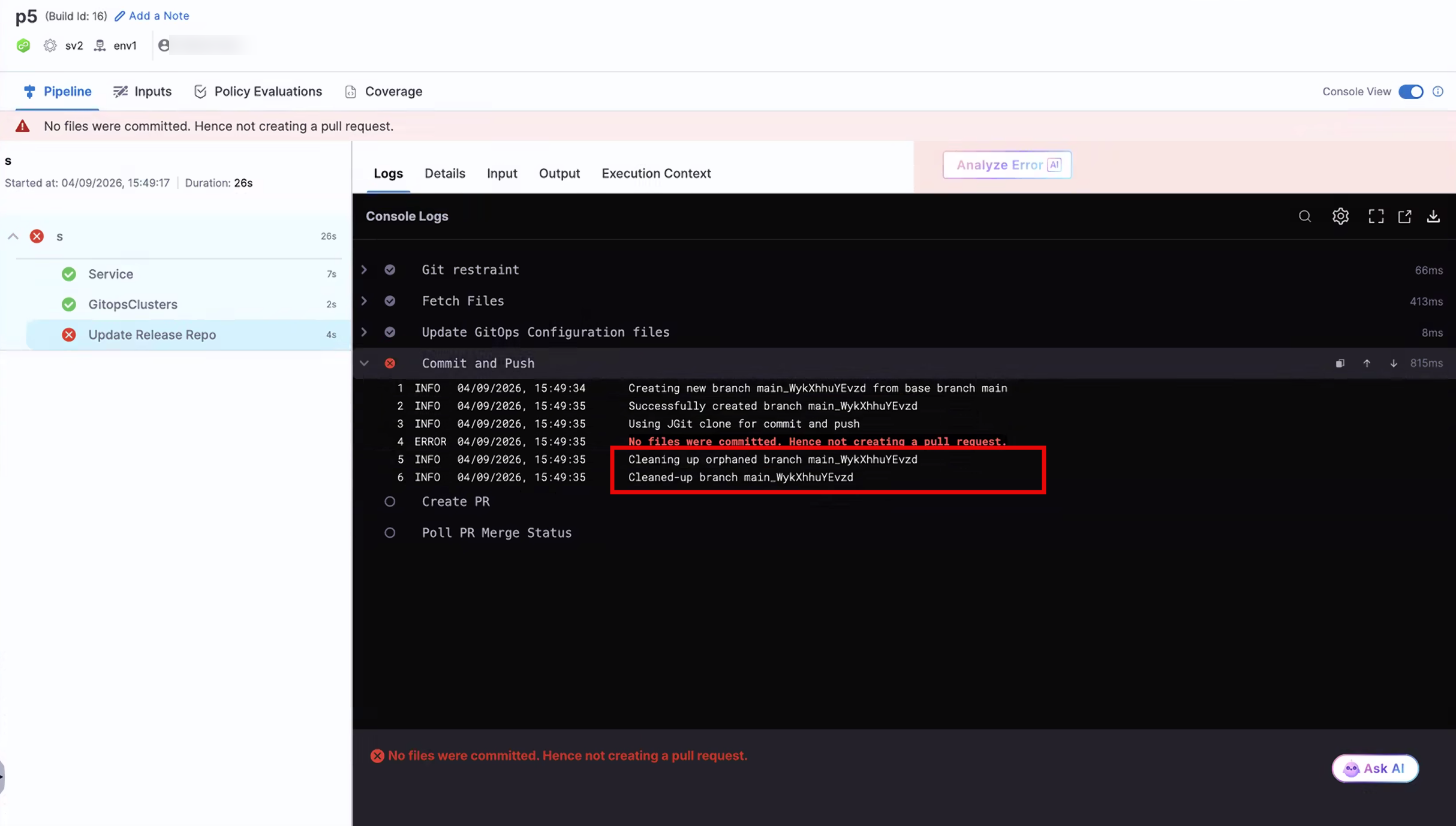
{% hint style="info" %}
**AUTOMATIC BRANCH CLEANUP**
If the step creates a branch but fails to create a PR (due to token issues, insufficient permissions, or no file changes), the branch is automatically deleted to prevent orphaned branches from accumulating in your repository.
The step logs show `Cleaning up orphaned branch ` and `Cleaned-up branch ` when this occurs.
{% endhint %}

#### Status checks in pull requests
The Update Release Repo step sends status updates to the pull request it creates, showing which pipeline created the PR and the deployment stage status directly in your Git provider.
When enabled, two status checks appear on the PR:
1. **Manifest update trigger** — Posted immediately when the PR is created. Shows the pipeline name and links to pipeline step execution.
2. **Stage execution status** — Posted when the stage completes. Shows whether the stage passed or failed and links to pipeline stage execution.

These checks help you track which pipeline execution is responsible for a given manifest change and whether the deployment stage succeeded.
**Requirements:**
* Feature flag `CDS_GITOPS_SEND_STATUS_TO_GIT_DISABLED` must be **off** (contact Harness Support to disable).
* Delegate version **26.08.89900** or later.
* SCM connector must use a supported provider (see table below).
**Enable status checks:**
Add `sendGitStatus` configuration at the stage level with `enabled: true`:
```yaml
- stage:
name: s
identifier: s
description: ""
type: Deployment
sendGitStatus:
enabled: true
spec:
deploymentType: Kubernetes
gitOpsEnabled: true
execution:
steps:
- step:
type: GitOpsUpdateReleaseRepo
name: Update Release Repo
identifier: updateReleaseRepo
# ... step configuration ...
```

**SCM provider support:**
The following table summarizes SCM provider support for manifest update triggers and stage execution status reporting:
| Provider | Manifest update trigger | Stage execution status | Notes |
| -------------------------- | ----------------------- | ---------------------- | ------------------------------------------------------------------------------------------------------------- |
| GitHub | ✅ | ✅ | |
| GitLab | ✅ | ✅ | |
| Bitbucket Cloud | ✅ | ✅ | |
| Bitbucket Server | ✅ | ✅ | |
| Harness Code Repository | ✅ | ✅ | |
| Azure DevOps (Azure Repos) | ❌ | ✅ | Does not support the initial manifest update trigger status. Only posts stage execution status on completion. |
***
#### Merge PR
Merges the PR created by Update Release Repo.
| Parameter | Type | Required | Description |
| ------------------------------------------------- | -------------- | ------------ | ---------------------------------------------------------------------------------------------------------------------------------------------------------------------------------------------------------------------------------------------------------------------------------- |
| **Merge Strategy Type** (`mergeStrategy`) | enum | No (`merge`) | `merge`: preserves full commit history. `squash`: combines all PR commits into one commit on the target branch. |
| **Delete Source Branch** (`deleteSourceBranch`) | `boolean` | No (`false`) | Delete the PR source branch after merge completes. |
| **API Parameters** | `list
 The step logs show `Cleaning up orphaned branch