> For the complete documentation index, see [llms.txt](https://developer.harness.io/llms.txt). Markdown versions of documentation pages are available by appending `.md` to page URLs; this page is available as [Markdown](https://developer.harness.io/web-application-and-api-protection-waap-discovery-discovery-api-security-testing/api-security-testing/ast-basics-and-workflow/apist-issues.md).

# APIST Issues

Understand how API Security Testing detects issues, and use the Issues page to review, filter, group and prioritize them for remediation

<details>

<summary>Updates (October 2026 to December 2026)</summary>

* *October 2026*: Updated the filter from "Is External" to "Is Internet-Facing". Go to [Filter options](#filter-options) for more details.

</details>

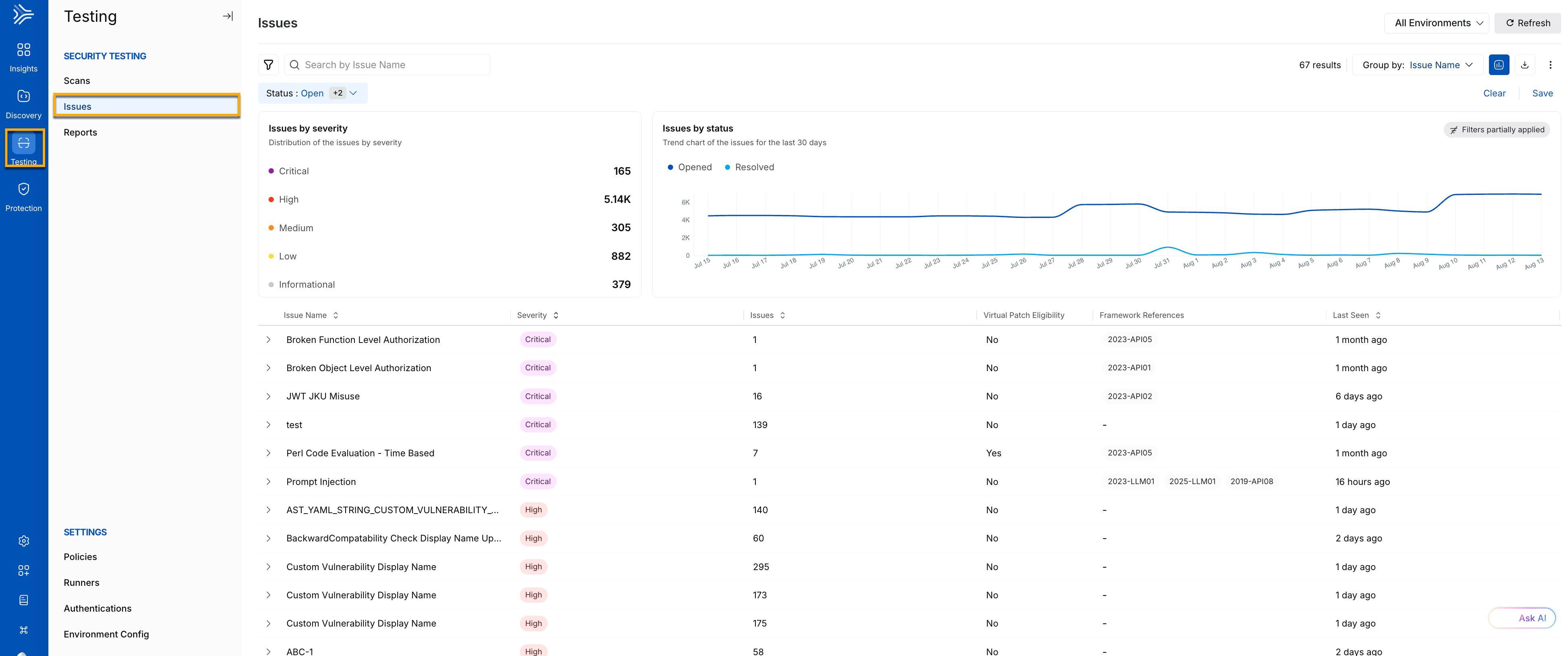
The **Issues** page serves as your central command center for monitoring API risks identified by Harness RPA through security testing scans. If you are responsible for the API security of the organization and want to view issues identified via APIST scans, you log into Harness RPA and head over to the **Testing** → **Issues** page. This page serves as a hub for identifying all potential vulnerabilities and risky patterns through scans.

<figure><img src="https://1414883571-files.gitbook.io/~/files/v0/b/gitbook-x-prod.appspot.com/o/spaces%2Fdr7UJpJrdGkkSGT6AFTu%2Fuploads%2Fgit-blob-510c800606d6d8106af0ef4075802900268198c9%2FTraceable_APIST_Issues_page_main_page-ues7e8.png?alt=media" alt="" width="750"><figcaption><p>Issues</p></figcaption></figure>

## What you will learn from this topic

By the end of this topic, you will be able to understand:

* What issues are, and how Harness RPA detects them through APIST scans.
* How to use the Issues page to review and assess detected security issues.
* How to interpret issue severity, status, and other key details in the issue listing.
* How to use grouping and filters to organize issues and prioritize findings for investigation and remediation.
* How to use additional options, such as search, saved filters, visualization, and issue downloads.
* Where to manage and remediate the issues you identify.

If you already understand these components, go to [Manage Issues](https://developer.harness.io/web-application-and-api-protection-waap-discovery-discovery-api-security-testing/api-security-testing/ast-basics-and-workflow/apist-issues/manage-issues.md) for more details on how to drill down and manage an issue. Go to [Remediate Issues](https://developer.harness.io/web-application-and-api-protection-waap-discovery-discovery-api-security-testing/api-security-testing/ast-basics-and-workflow/apist-issues/remediate-issues.md) for more details on how to fix an issue.

***

## Understand issues

Issues are security gaps in your API definitions that threat actors may exploit to attack your API infrastructure. Harness RPA identifies API assets, endpoints, including AI endpoints, and services through the discovery process. Go to [API discovery](https://developer.harness.io/web-application-and-api-protection-waap-discovery-discovery-api-security-testing/settings/discovery/api-discovery.md) for more details. After discovery, you can configure APIST scans to identify issues based on the policies you select. The following table provides an overview of issues and how Harness RPA detects and manages them:

| What are issues?                                                                                                                           | Why do they matter?                                                                                                                                                                          | How does Harness RPA detect them?                                                                                                                   | What can you do with them?                                                                                                                                                                                 |
| ------------------------------------------------------------------------------------------------------------------------------------------ | -------------------------------------------------------------------------------------------------------------------------------------------------------------------------------------------- | --------------------------------------------------------------------------------------------------------------------------------------------------- | ---------------------------------------------------------------------------------------------------------------------------------------------------------------------------------------------------------- |
| **Issues** are security gaps in your API definitions that threat actors may exploit to compromise your APIs or application infrastructure. | Issues can expose sensitive data, weaken your API security posture, or allow attackers to compromise application functionality. Identifying and addressing them helps reduce security risks. | Harness RPA evaluates discovered APIs during APIST scans against the configured policies and identifies issues based on the defined security rules. | Review issue details, assess severity and risk, prioritize remediation, and manage issue status. Harness RPA continues to monitor API endpoints through subsequent scans, even after an issue is resolved. |

Go to [Creating a Scan](https://developer.harness.io/web-application-and-api-protection-waap-discovery-discovery-api-security-testing/api-security-testing/ast-basics-and-workflow/creating-a-scan.md) and [Policies](https://developer.harness.io/web-application-and-api-protection-waap-discovery-discovery-api-security-testing/api-security-testing/advanced-usage/policies.md) for more details about setting up a scan and a policy, respectively.

{% hint style="info" %}
Harness RPA does not scan APIs for issues while they are in the learning phase.
{% endhint %}

You can use the **Issues** page to review issue severity, understand issue details, investigate risks, and prioritize remediation. Go to [Manage Issues](https://developer.harness.io/web-application-and-api-protection-waap-discovery-discovery-api-security-testing/api-security-testing/ast-basics-and-workflow/apist-issues/manage-issues.md) for more details about granular details of an issue, managing its status, and the rules for resolving or deleting issues. Go to [Remediate Issues](https://developer.harness.io/web-application-and-api-protection-waap-discovery-discovery-api-security-testing/api-security-testing/ast-basics-and-workflow/apist-issues/remediate-issues.md) for more details about remediating an issue.

***

## Issue severity

Harness RPA assigns a severity level to each detected issue based on its potential impact and risk to your application ecosystem. You can find the distribution of the issues by severity on the **Issues by severity** widget. The following table lists the severity levels in descending order:

| Severity          | Description                                                                                                                                           |
| ----------------- | ----------------------------------------------------------------------------------------------------------------------------------------------------- |
| **Critical**      | Issues that pose the highest risk and require immediate remediation to prevent significant security breaches.                                         |
| **High**          | Issues that may expose sensitive data or compromise system integrity if not addressed promptly.                                                       |
| **Medium**        | Issues that present a moderate security risk and may weaken your security posture over time.                                                          |
| **Low**           | Issues with limited impact that can typically be addressed as part of routine maintenance.                                                            |
| **Informational** | Findings that do not represent a direct security risk but provide useful context, such as configuration details, exposed metadata, or usage patterns. |

***

## Key components

The page contains key components that help you quickly assess and understand issues. Below are the main elements of the page and their significance:

<figure><img src="https://1414883571-files.gitbook.io/~/files/v0/b/gitbook-x-prod.appspot.com/o/spaces%2Fdr7UJpJrdGkkSGT6AFTu%2Fuploads%2Fgit-blob-be0c5377fb6476d0af765d46d5a2be2d28a6ffba%2FTracable_APIST_Issues_main_Page_granular_drill_down-1--xvncu1.png?alt=media" alt="" width="983"><figcaption><p>Issues Key Components</p></figcaption></figure>

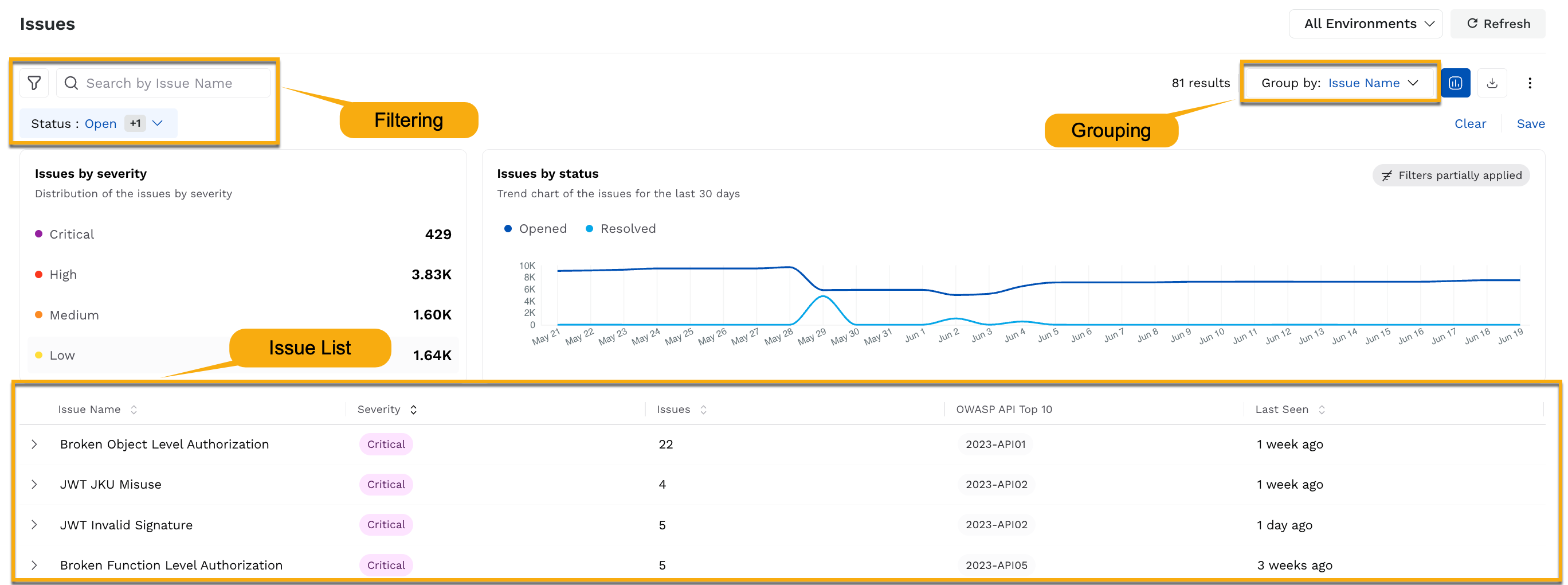
When you first land on the **Issues** page, Harness RPA shows a table of detected issues, grouped by their name. This table displays key information, including **Severity**, **Last Seen**, and the count of **API Endpoints** where the issue was observed. The grouping and filtering options enable you to narrow your focus based on a specific indicator. You can also view more details for a specific issue, such as Overview, References, and Status Log. You can view the evidence for a particular issue for deeper analysis of the data, including its URL, status code, last seen, mutations, and assertions. Go to [Issue details panel](https://developer.harness.io/web-application-and-api-protection-waap-discovery-discovery-api-security-testing/api-security-testing/ast-basics-and-workflow/apist-issues/manage-issues.md#issue-details-panel) for more details.

### Issues view

When you first land on the **Issues** page, Harness RPA displays a list of detected issues in the *Open*, *Reopened*, and *Under Review* states, grouped by their name. The grouping and filtering options enable you to narrow your focus based on a specific indicator. Go to [Actions on the Issues page](#actions-on-the-issues-page) for more details. This page serves as a dashboard where you can:

<figure><img src="https://1414883571-files.gitbook.io/~/files/v0/b/gitbook-x-prod.appspot.com/o/spaces%2Fdr7UJpJrdGkkSGT6AFTu%2Fuploads%2Fgit-blob-87d5ebc4230d8869665ae6174ef86c02e27d89f7%2Ftraceable_ast_issue_management_issues_view-7o7eft.png?alt=media" alt="Issues View" width="943"><figcaption><p>Issues View</p></figcaption></figure>

* **View listed issues**: Each issue is presented with details, such as its severity and the number of endpoints it was observed in. Go to [Issue table](#issues-table) for more details.
* **Group and filter**: While Harness RPA groups the data on the page based on **Issue Names** by default, you can group the data based on other categories as well. Additionally, you can filter data based on the impact of the issue or your specific requirements. Go to [Group By options](#group-by-options) and [Filter options](#filter-options) for more details.

### Visual insights

At the top of the Issues page, Harness RPA shows the following widgets:

| Chart                  | Description                                                                                                                                                         |
| ---------------------- | ------------------------------------------------------------------------------------------------------------------------------------------------------------------- |
| **Issues by severity** | Shows the count of issues by severity. You can click a severity level to filter the results accordingly. Go to [Issue severity](#issue-severity) for more. details. |
| **Issues by status**   | Shows a trend of the open and resolved issues over the past 30 days.                                                                                                |

Collectively, these widgets provide an overview of the security posture and trends of your application, helping you identify areas that need attention and take appropriate action.

### **Issues table**

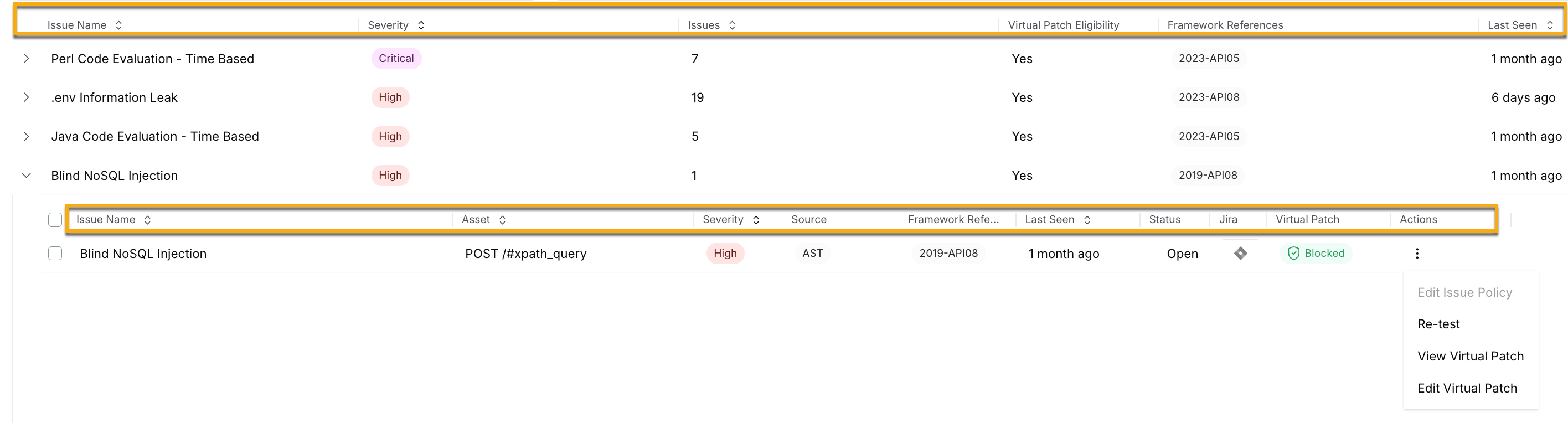
Each entry in the **Issues** table represents an issue detected during an APIST scan. The table groups issues by **Issue Name** and lists issues with **Status** selected as *Open, Reopened* and *Under Review* by default. This table provides key details to help you understand the finding, assess its severity, and determine its remediation status.

<figure><img src="https://1414883571-files.gitbook.io/~/files/v0/b/gitbook-x-prod.appspot.com/o/spaces%2Fdr7UJpJrdGkkSGT6AFTu%2Fuploads%2Fgit-blob-62e01136cf50e0556a8331442c79861b4a606a6b%2FTraceable_APIST_issues_listing-zr3jd9.png?alt=media" alt="" width="750"><figcaption><p>Issues Table</p></figcaption></figure>

#### **Grouped rows**

The table below describes the attributes in each grouped row when the table is grouped by *Issue Name*:

| Attribute                     | Description                                                                                                                                                                                                                                                                                                                                                                                             |
| ----------------------------- | ------------------------------------------------------------------------------------------------------------------------------------------------------------------------------------------------------------------------------------------------------------------------------------------------------------------------------------------------------------------------------------------------------- |
| **Issue Name**                | Displays the name of the detected issue, such as *Broken Function Level Authorization*, *JWT JKU Misuse*, or *Prompt Injection*.                                                                                                                                                                                                                                                                        |
| **Severity**                  | Displays the severity assigned to the issue: *Critical*, *High*, *Medium*, *Low*, or *Informational*. This helps you assess the potential impact and prioritize remediation.                                                                                                                                                                                                                            |
| **Issues**                    | Displays the number of occurrences Harness RPA detected for the issue. For example, a value of *16* indicates that Harness RPA detected *16* occurrences of that issue.                                                                                                                                                                                                                                 |
| **Virtual Patch Eligibility** | Displays whether the issue is eligible for a virtual patch. *Yes* indicates that the issue can potentially be mitigated using a virtual patch. Go to [Virtual Patching](https://developer.harness.io/web-application-and-api-protection-waap-discovery-discovery-api-security-testing/api-security-testing/ast-basics-and-workflow/apist-issues/remediate-issues/virtual-patching.md) for more details. |
| **Framework References**      | Displays the security framework references associated with the issue, such as *2023-API01*, *2023-API05*, or *2025-LLM01*.                                                                                                                                                                                                                                                                              |
| **Last Seen**                 | Displays when Harness RPA most recently observed the issue. This helps you understand whether the issue is still being detected and how recently it was active.                                                                                                                                                                                                                                         |

Go to [Issue details panel](https://developer.harness.io/web-application-and-api-protection-waap-discovery-discovery-api-security-testing/api-security-testing/ast-basics-and-workflow/apist-issues/manage-issues.md#issue-details-panel) for more details on an issue and how to manage it individually according to your requirements.

#### **Issue occurrence list**

The issue occurrence list displays each occurrence of the issue against a different asset. When you expand a grouped row, Harness RPA lists the first four occurrences. The table below describes the columns for each issue occurrence:

| Attribute                                                                                                                                                                                                                                                                      | Description                                                                                                                                                                                                                                                                                                                                                                                                                                                                                   |
| ------------------------------------------------------------------------------------------------------------------------------------------------------------------------------------------------------------------------------------------------------------------------------ | --------------------------------------------------------------------------------------------------------------------------------------------------------------------------------------------------------------------------------------------------------------------------------------------------------------------------------------------------------------------------------------------------------------------------------------------------------------------------------------------- |
| **Checkbox**                                                                                                                                                                                                                                                                   | Selects the occurrence for a bulk action. Go to [Update issues](https://developer.harness.io/web-application-and-api-protection-waap-discovery-discovery-api-security-testing/api-security-testing/ast-basics-and-workflow/apist-issues/remediate-issues.md#update-issues) for more details.                                                                                                                                                                                                  |
| **Issue Name**                                                                                                                                                                                                                                                                 | Displays the issue name. Click it to open the issue details panel. Go to [Issue details panel](https://developer.harness.io/web-application-and-api-protection-waap-discovery-discovery-api-security-testing/api-security-testing/ast-basics-and-workflow/apist-issues/manage-issues.md#issue-details-panel) for more details.                                                                                                                                                                |
| **Asset**                                                                                                                                                                                                                                                                      | Displays the API endpoint where Harness RPA detected the occurrence, for example, *POST /treasury/payment-validation*.                                                                                                                                                                                                                                                                                                                                                                        |
| **Severity**                                                                                                                                                                                                                                                                   | Displays the severity of the occurrence.                                                                                                                                                                                                                                                                                                                                                                                                                                                      |
| **Source**                                                                                                                                                                                                                                                                     | Displays the origin of the issue. For issues detected by a scan, the value is *AST*.                                                                                                                                                                                                                                                                                                                                                                                                          |
| **Framework References**                                                                                                                                                                                                                                                       | Displays the security framework category the occurrence maps to.                                                                                                                                                                                                                                                                                                                                                                                                                              |
| **Last Seen**                                                                                                                                                                                                                                                                  | Displays when Harness RPA last detected the occurrence.                                                                                                                                                                                                                                                                                                                                                                                                                                       |
| **Status**                                                                                                                                                                                                                                                                     | Displays the current status of the occurrence. This serves as a communication medium to indicate whether or not an issue requires prioritization. Click the drop-down to change it. Go to [Change the status of an issue](https://developer.harness.io/web-application-and-api-protection-waap-discovery-discovery-api-security-testing/api-security-testing/ast-basics-and-workflow/apist-issues/manage-issues.md#change-the-status-of-an-issue) for more details on the available statuses. |
| **Jira (**<img src="https://1414883571-files.gitbook.io/~/files/v0/b/gitbook-x-prod.appspot.com/o/spaces%2Fdr7UJpJrdGkkSGT6AFTu%2Fuploads%2Fgit-blob-8a7b454fb621508e8bdc63f2aa5bbaa9c83de5e6%2Ftraceable_ast_issuesmgmt_jiraicon.png?alt=media" alt="" data-size="line">**)** | Displays the Jira icon. Click it to create a Jira ticket for the occurrence directly from the Harness RPA platform. Go to [Create a ticket](https://developer.harness.io/web-application-and-api-protection-waap-discovery-discovery-api-security-testing/api-security-testing/ast-basics-and-workflow/apist-issues/remediate-issues.md#create-a-ticket) for more details.                                                                                                                    |
| **Virtual Patch**                                                                                                                                                                                                                                                              | Displays the virtual patch state of the occurrence, for example, *No Patch*.                                                                                                                                                                                                                                                                                                                                                                                                                  |
| **Actions**                                                                                                                                                                                                                                                                    | Displays the actions menu for the occurrence. You can re-test the issue, in which case Harness RPA displays a pop-up window where you can run a scan using the terminal or the platform. If the issue is eligible for virtual patching, you can also create, view, or edit its virtual patch.                                                                                                                                                                                                 |

{% hint style="info" %}
The Jira icon is enabled only when you configure the Jira integration. Go to [Jira integration](https://developer.harness.io/web-application-and-api-protection-waap-discovery-discovery-api-security-testing/integrations/project-management/jira-integration.md) for more details.
{% endhint %}

### Actions on the Issues page

Harness RPA provides the following actions to narrow and organize the issues table:

| Feature                                                                                                                                                                                                                                                                   | Description                                                                                                                                                                                                                                                                                                                                 |
| ------------------------------------------------------------------------------------------------------------------------------------------------------------------------------------------------------------------------------------------------------------------------- | ------------------------------------------------------------------------------------------------------------------------------------------------------------------------------------------------------------------------------------------------------------------------------------------------------------------------------------------- |
| **Filter** (<i class="fa-filter">:filter:</i>) icon                                                                                                                                                                                                                       | Narrow the issue list based on criteria such as status, severity, source, timestamp, or sensitivity. You can save filters for reuse from **Filter → Saved**. Go to [Filter options](#filter-options) for more details on available filters.                                                                                                 |
| **Search** (<i class="fa-searchengin">:searchengin:</i>)                                                                                                                                                                                                                  | Locate an issue by entering its name in the search bar.                                                                                                                                                                                                                                                                                     |
| **Group by** drop down                                                                                                                                                                                                                                                    | Harness RPA groups issues by issue name by default. You can group them on several other criteria. Go to [Group by options](#group-by-options) for more details.                                                                                                                                                                             |
| **Visualization** (<img src="https://1414883571-files.gitbook.io/~/files/v0/b/gitbook-x-prod.appspot.com/o/spaces%2Fdr7UJpJrdGkkSGT6AFTu%2Fuploads%2Fgit-blob-5cb88f2afa18930e6809fd28c3a45a9aa8880388%2Fimage-63--e3rqj7.png?alt=media" alt="" data-size="line">) toggle | Show or hide the visual insights section on the **Issues** page.                                                                                                                                                                                                                                                                            |
| **Download** (<i class="fa-download">:download:</i>) icon                                                                                                                                                                                                                 | Download the issue listing for offline analysis. Go to [Manage Issues](https://developer.harness.io/web-application-and-api-protection-waap-discovery-discovery-api-security-testing/api-security-testing/ast-basics-and-workflow/apist-issues/manage-issues.md) for more details on managing issues based on the above groups and filters. |

#### Filter options

You can use filters to narrow the list of issues and focus on the findings that matter to you. You can filter issues by their status and severity, the affected API or application, the scan that detected them, and security characteristics such as authentication, encryption, and sensitive data. The following table describes the available filter options grouped by category:

<table data-header-hidden><thead><tr><th></th><th></th><th></th></tr></thead><tbody><tr><td>Category</td><td>Filter</td><td>Description</td></tr><tr><td rowspan="18"><strong>Issue</strong></td><td><strong>Status</strong></td><td>Specifies the current status of the issue, helping you identify findings that are open, resolved, or in another stage of the issue lifecycle.</td></tr><tr><td><strong>Severity</strong></td><td>Specifies the severity assigned to the issue, such as <em>Critical, High, Medium, Low</em>, or <em>Informational,</em> helping you prioritize findings based on their potential impact and urgency.</td></tr><tr><td><strong>Framework References</strong></td><td>Specifies the security frameworks or standards associated with the issue, helping you relate the finding to specific security requirements or controls.</td></tr><tr><td><strong>Category</strong></td><td>Specifies the security category for the issue, helping you group findings by the type of security risk they represent.</td></tr><tr><td><strong>Issue Name</strong></td><td>Specifies the name of the detected issue, such as <em>Broken Object Level Authorization</em>. Use this to find a specific vulnerability or review occurrences of the same issue type.</td></tr><tr><td><strong>Created Timestamp</strong></td><td>Specifies when the issue was first created, helping you understand when the finding was initially detected.</td></tr><tr><td><strong>Closed Timestamp</strong></td><td>Specifies when the issue was closed, helping you identify findings that were resolved during a specific period.</td></tr><tr><td><strong>Environment</strong></td><td>Specifies the environment associated with the issue, helping you focus on findings from a particular deployment environment.</td></tr><tr><td><strong>Is AI Asset</strong></td><td>Specifies whether the affected asset is identified as an AI asset, allowing you to focus on findings associated with AI APIs and other AI-related assets.</td></tr><tr><td><strong>Issue Id</strong></td><td>Specifies the unique identifier assigned to the issue, allowing you to locate a specific finding or correlate it with an issue referenced elsewhere.</td></tr><tr><td><strong>Asset</strong></td><td>Specifies the asset where Harness RPA observed the issue, including APIs and AI APIs.</td></tr><tr><td><strong>Asset Type</strong></td><td>Specifies the type of asset affected by the issue, helping you distinguish between different asset types during investigation.</td></tr><tr><td><strong>Application Name</strong></td><td>Specifies the application associated with the affected asset, helping you identify which application may be impacted by the finding.</td></tr><tr><td><strong>Jira Created</strong></td><td>Specifies whether a Jira issue has been created for the finding, helping you distinguish findings that are already being tracked from those that still require a ticket.</td></tr><tr><td><strong>Jira Issue</strong></td><td>Specifies the Jira issue associated with the Harness RPA finding, helping you locate findings that are already being tracked and managed in Jira.</td></tr><tr><td><strong>Scan Run</strong></td><td>Specifies the APIST scan run in which Harness RPA detected the issue, helping you trace the finding back to the specific scan execution.</td></tr><tr><td><strong>Scan</strong></td><td>Specifies the APIST scan associated with the issue, helping you understand which configured scan identified the finding.</td></tr><tr><td><strong>Virtual Patch Eligible</strong></td><td>Specifies whether the issue is eligible for a virtual patch, helping you identify findings that may be mitigated while a permanent fix is implemented.</td></tr><tr><td rowspan="15"><strong>Endpoint</strong></td><td><strong>Endpoint</strong></td><td>Specifies the endpoint associated with the issue, helping you identify the specific API operation where the security gap was observed.</td></tr><tr><td><strong>API Endpoint</strong></td><td>Specifies the API endpoint affected by the issue, helping you identify the API operation that requires investigation or remediation.</td></tr><tr><td><strong>Service</strong></td><td>Specifies the service associated with the affected endpoint, helping you identify the backend service involved in the finding.</td></tr><tr><td><strong>Is Internet-Facing</strong></td><td>Specifies whether the affected endpoint or API is internet-facing, helping you distinguish externally exposed APIs from internal APIs.</td></tr><tr><td><strong>Labels</strong></td><td>Specifies the labels associated with the affected endpoint or issue, providing additional context and helping you organize findings according to your organization's conventions.</td></tr><tr><td><strong>Datatype</strong></td><td>Specifies the data type associated with the affected endpoint or API field, helping you identify findings involving specific types of data.</td></tr><tr><td><strong>Dataset</strong></td><td>Specifies the dataset associated with the affected endpoint or data, allowing you to narrow findings to APIs handling a particular dataset.</td></tr><tr><td><strong>Owner</strong></td><td>Specifies the owner associated with the affected endpoint or issue, helping you identify the team or individual responsible for investigation and remediation.</td></tr><tr><td><strong>Sensitivity</strong></td><td>Specifies the sensitivity classification associated with the affected endpoint or data, helping you identify findings involving more sensitive information.</td></tr><tr><td><strong>Is Authenticated</strong></td><td>Specifies whether authentication is required to access the affected endpoint, helping you distinguish authenticated APIs from those exposed without authentication.</td></tr><tr><td><strong>Has Sensitive Data</strong></td><td>Specifies whether the affected endpoint handles sensitive data, helping you identify findings that may have a greater impact because sensitive information is involved.</td></tr><tr><td><strong>Risk Category</strong></td><td>Specifies the risk category associated with the affected endpoint, providing additional context about the security risk.</td></tr><tr><td><strong>Domain</strong></td><td>Specifies the domain associated with the affected endpoint, helping you narrow your findings to APIs within a specific domain or business area.</td></tr><tr><td><strong>Endpoint Type</strong></td><td>Specifies the type of endpoint associated with the issue, helping you distinguish findings across different endpoint types.</td></tr><tr><td><strong>Is Encrypted</strong></td><td>Specifies whether communication with the affected endpoint is encrypted, helping you identify findings involving endpoints that do not use encryption.</td></tr><tr><td rowspan="7"><strong>MCP Tool</strong></td><td><strong>Name</strong></td><td>Specifies the name of the MCP tool associated with the issue, helping you identify findings affecting a particular tool.</td></tr><tr><td><strong>Is Internet-Facing</strong></td><td>Specifies whether the MCP tool is internet-facing, helping you distinguish externally exposed tools from internal tools.</td></tr><tr><td><strong>Datatype</strong></td><td>Specifies the data type associated with the MCP tool, helping you narrow findings based on the type of data handled by the tool.</td></tr><tr><td><strong>Dataset</strong></td><td>Specifies the dataset associated with the MCP tool, allowing you to focus on findings involving a particular dataset.</td></tr><tr><td><strong>Is Authenticated</strong></td><td>Specifies whether authentication is required to access or use the MCP tool.</td></tr><tr><td><strong>Has Sensitive Data</strong></td><td>Specifies whether the MCP tool handles sensitive data, helping you identify findings involving tools that process sensitive information.</td></tr><tr><td><strong>Is Encrypted</strong></td><td>Specifies whether communication with the MCP tool is encrypted.</td></tr></tbody></table>

#### Group by options

While Harness RPA groups issues on the page by issue name, you can also filter and group them by several criteria. The following table describes the available categories for group by:

| Category                 | Description                                                                                                                                                                                                                                                                                                                                                                    |
| ------------------------ | ------------------------------------------------------------------------------------------------------------------------------------------------------------------------------------------------------------------------------------------------------------------------------------------------------------------------------------------------------------------------------ |
| **Issue Name**           | Groups issues based on the specific issue. This helps you understand how widespread an issue is across environments and focus on resolving the most recurring issues.                                                                                                                                                                                                          |
| **Category**             | Groups issues by broader classifications, such as Authentication, Authorization, or JSON Web Token. This helps you analyze the issues at a broader level to determine which are most common across the system.                                                                                                                                                                 |
| **Framework References** | Groups issues based on their mapping in framework reference categories. This helps you align your analysis with recognized industry standards.                                                                                                                                                                                                                                 |
| **Asset**                | Groups issues based on the assets (endpoints) in which they were detected. This helps you analyze endpoint risk exposure and prioritize resolution based on it.                                                                                                                                                                                                                |
| **Owner**                | Groups issues by the assigned API owner. This helps you direct these issues to the right individual or team for faster and effective resolution. Go to [API Ownership](https://developer.harness.io/web-application-and-api-protection-waap-discovery-discovery-api-security-testing/discovery/discovery-1/api-ownership.md) for more details on ownership and its assignment. |
| **Label**                | Groups issues based on the labels assigned to APIs. This helps you assess and prioritize issues by business function, risk, or internal tagging conventions.                                                                                                                                                                                                                   |
| **Domain**               | Groups issues by the API domain where the issue was detected. This helps you assess and prioritize issues by the application area or team affected.                                                                                                                                                                                                                            |

***

## Manage and remediate issues

After you review and prioritize issues, use [Manage Issues](https://developer.harness.io/web-application-and-api-protection-waap-discovery-discovery-api-security-testing/api-security-testing/ast-basics-and-workflow/apist-issues/manage-issues.md) to drill down into the evidence and context of an issue, update its status, and understand how Harness RPA resolves and deletes issues automatically.

To fix an issue, use [Remediate Issues](https://developer.harness.io/web-application-and-api-protection-waap-discovery-discovery-api-security-testing/api-security-testing/ast-basics-and-workflow/apist-issues/remediate-issues.md), which covers configuring integrations, creating tickets in Jira, ServiceNow ITSM, or Azure DevOps, and updating issues individually or in bulk. To protect an endpoint while your team works on the code-level fix, use [Virtual Patching](https://developer.harness.io/web-application-and-api-protection-waap-discovery-discovery-api-security-testing/api-security-testing/ast-basics-and-workflow/apist-issues/remediate-issues/virtual-patching.md).

{% @harness-feedback/feedback %}