> For the complete documentation index, see [llms.txt](https://developer.harness.io/llms.txt). Markdown versions of documentation pages are available by appending `.md` to page URLs; this page is available as [Markdown](https://developer.harness.io/web-application-and-api-protection-waap-discovery-discovery-protection-protection/protection/settings/web-application-firewall-policies/profiles-and-overrides-in-waf-policies.md).

# Profiles and Overrides in WAF Policies

Manage WAF policy profiles and environment overrides to control threat rule actions per environment

**Profiles** in Harness’s Web Application Firewall (WAF) Policies provide a structured way for you to manage threat rule actions across environments. These profiles enable you to enforce protection standards by applying default actions, such as monitoring or blocking, across all threat types and rules. This helps reduce manual configuration overhead while enabling you to focus on improving your application security.

While the selected profile applies to all environments by default, **Overrides** allow individual environments to differ from the default profile to meet your requirements. Whether you modify specific actions for threat rules or select a different profile, Harness RPA displays these deviations through overrides and helps you manage exceptions. Go to [Overrides](#overrides) for details.

Using Profiles and Overrides, you can leverage centralized policy enforcement and environment-specific flexibility to manage how Traceable responds to threats.

***

## What you will learn from this topic

By the end of this topic, you will understand:

* The concept of Profiles, the available profiles, and their applicability.
* The concept of Profile inheritance and hierarchy, and its usefulness.
* The concept of Overrides, their usefulness, and visibility of overrides in the Traceable.
* An example of policy inheritance and overrides in action.

***

## Profiles

Profiles are predefined configurations of actions set for all threat types and their corresponding rules. The actions define how Traceable should respond to potential threats in your application environment.

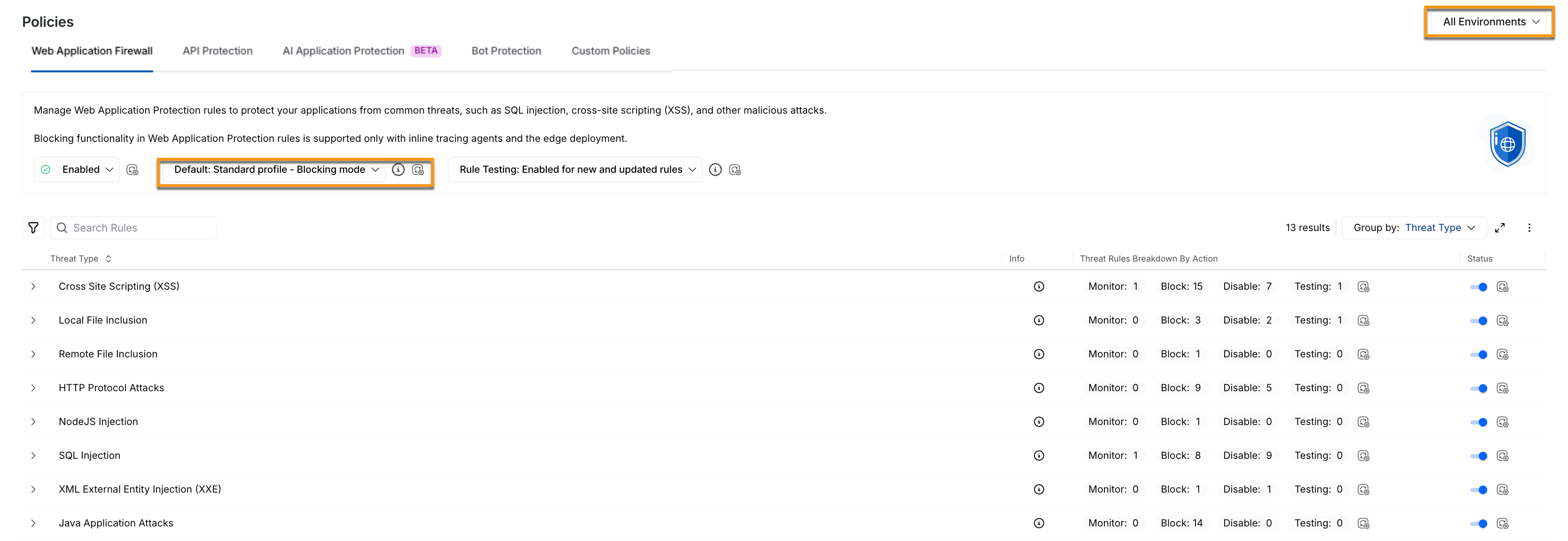
The **Profiles** in the **WAF** policies tab help you apply a baseline for actions consistent with your security posture.

<figure><img src="https://1414883571-files.gitbook.io/~/files/v0/b/gitbook-x-prod.appspot.com/o/spaces%2Fdr7UJpJrdGkkSGT6AFTu%2Fuploads%2Fgit-blob-2fe28f54d4bab8ec77ffb698b37aa104331c8afd%2FTraceable_web_app_protection_profile-1-1--23ya0g.png?alt=media" alt="" width="994"><figcaption><p>WAF Policies Profile</p></figcaption></figure>

### Available profiles

Traceable provides the following standard profiles in the WAF Policies tab:

<table><thead><tr><th width="241.59375">Profiles</th><th>Description</th></tr></thead><tbody><tr><td><strong>Monitor Mode</strong></td><td><p>This profile sets all non-aggressive and aggressive threat rules to the <em>Monitor</em> and <em>Disable</em> status, respectively.</p><p><strong>Recommendation</strong></p><p>You should use this mode if you wish to observe behavior in environments before enforcing protection.</p></td></tr><tr><td><strong>Block Mode</strong></td><td><p>This profile sets all non-aggressive and aggressive threat rules to the <em>Block</em> and <em>Disable</em> status, respectively.</p><p><strong>Recommendation</strong></p><p>You should use this mode if you wish to proactively prevent threats from affecting your production environments.</p></td></tr></tbody></table>

### Applicability of profiles

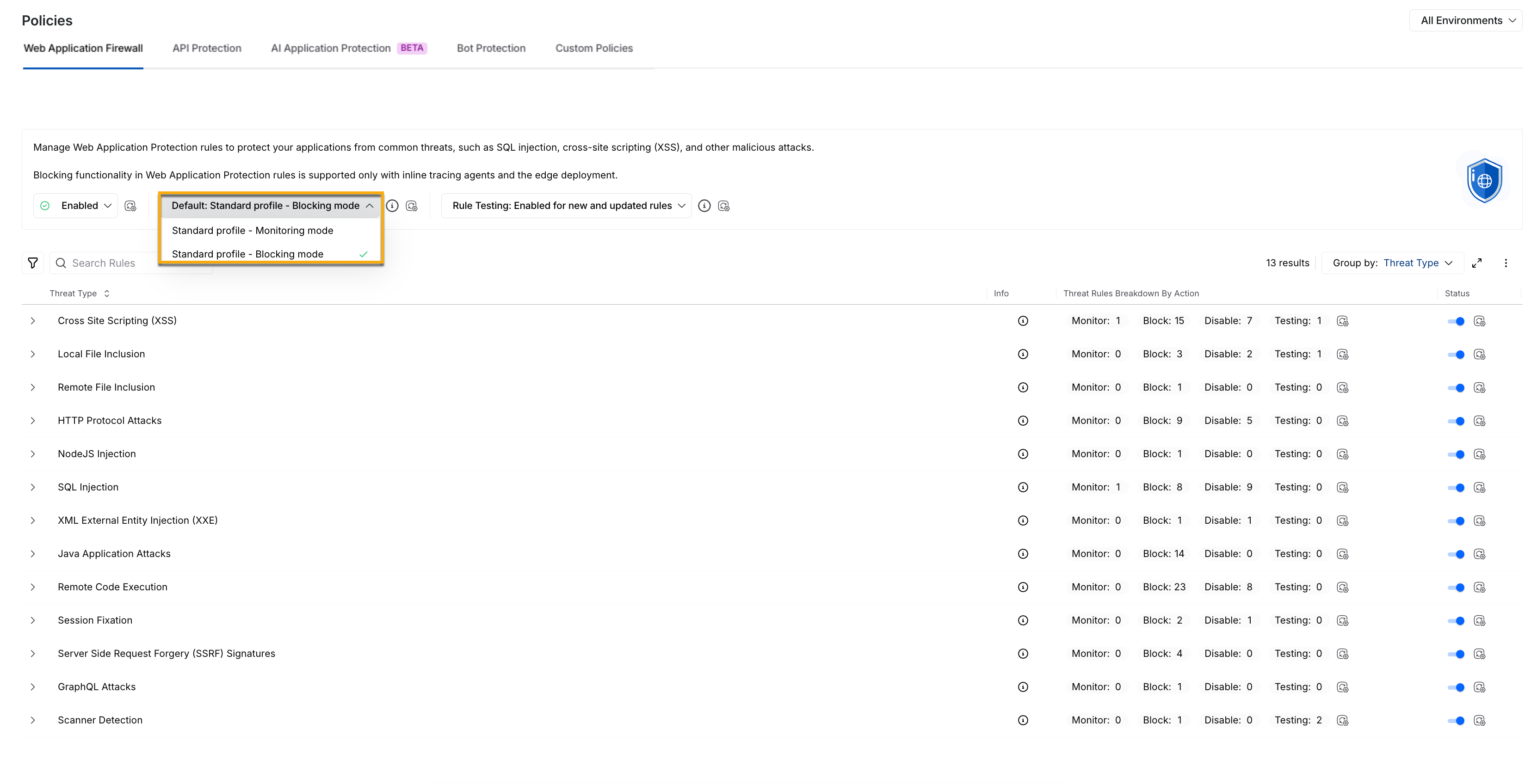
You can select these profiles at the *All Environments* level to apply globally, or at an individual environment level, according to your requirements. When you choose a profile, its predefined actions apply to all threat types and rules in the selected environment context. Regardless of the profile you choose, you can always override the actions for a threat rule or type, according to your requirements.

***

## Profile inheritance and hierarchy

Profile configuration in the WAP policies tab adheres to a top-down inheritance model, enabling you to maintain consistency while supporting environment-specific customizations.

At the highest level, you can select a profile in the **All Environments** view. The profile (*Monitoring* or *Blocking Mode*) you choose serves as the baseline (default), automatically applying the predefined actions to all environments unless you explicitly navigate to the respective environment and [override](#overrides) them.

<figure><img src="https://1414883571-files.gitbook.io/~/files/v0/b/gitbook-x-prod.appspot.com/o/spaces%2Fdr7UJpJrdGkkSGT6AFTu%2Fuploads%2Fgit-blob-29d87abed48cd82b25ecbb520c0071d5883281cd%2Ftraceable_protection_policies_inheritance-bvlktb.png?alt=media" alt="" width="996"><figcaption><p>Global Profile (Baseline) in All Environments</p></figcaption></figure>

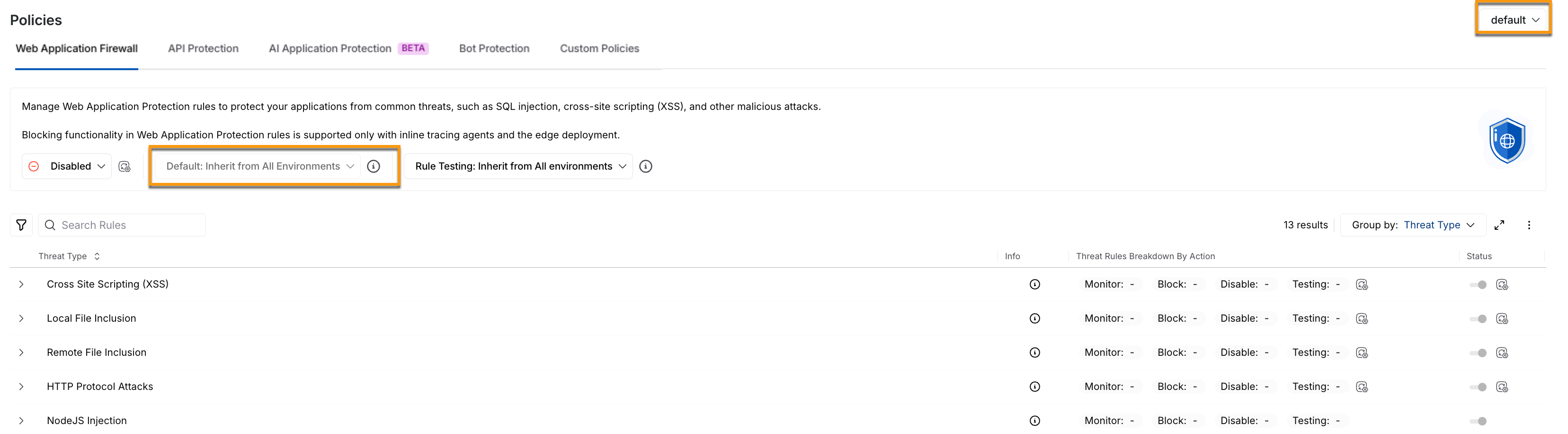
By default, all individual environments inherit the selected profile from *All Environments*, including the associated threat type and rule actions. This ensures that updates made to the global profile (All environments view), such as switching from *Monitor* to *Block* mode, are reflected across environments that do not have any overrides.

<figure><img src="https://1414883571-files.gitbook.io/~/files/v0/b/gitbook-x-prod.appspot.com/o/spaces%2Fdr7UJpJrdGkkSGT6AFTu%2Fuploads%2Fgit-blob-a1966950b4258ba5e76a01cbb6dd26b20feec394%2Ftraceable_protection_policies_hierarchy-fu1q0k.png?alt=media" alt="" width="985"><figcaption><p>Profile Inheritance in Environments</p></figcaption></figure>

However, environments can override this inherited behavior in the following ways:

* Selecting a different profile.
* Modifying the status or action of a threat type or rule.

Go to [Overrides](#overrides) for details.

### Hierarchy Usage

This profile hierarchy helps you:

* Apply standard protection strategies across environments.
* Make modifications to specific environments according to your requirements.
* Maintain visibility and control over new and existing overrides.

***

## Overrides

Overrides occur when an environment or configuration (threat type or rule) no longer follows the global profile (actions set at the *All Environments* level).

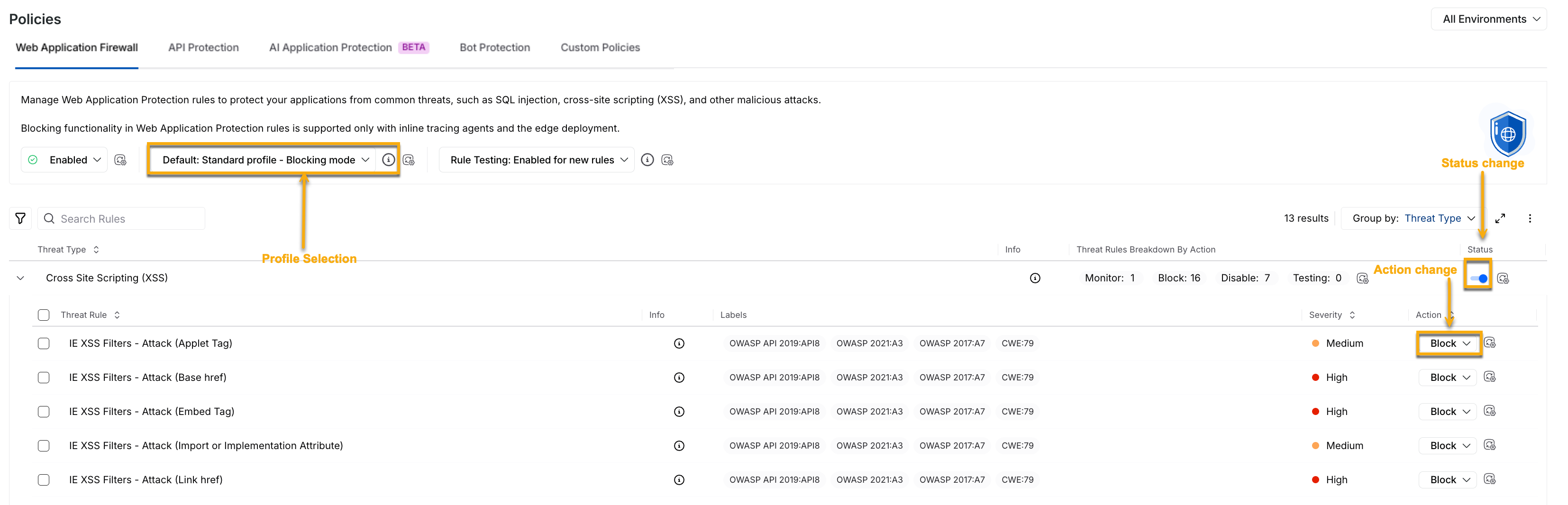
When you select a profile, such as the *Monitor* or *Block* mode at the *All Environments* level, Traceable applies its predefined actions to all threat types and rules across environments. Until you navigate to the respective environment and make any changes, it continues to inherit the existing action. However, if you perform any of the following actions, Traceable considers it an override:

<figure><img src="https://1414883571-files.gitbook.io/~/files/v0/b/gitbook-x-prod.appspot.com/o/spaces%2Fdr7UJpJrdGkkSGT6AFTu%2Fuploads%2Fgit-blob-27cccc59e4816fab6d29f14eac77ea0d696ce8c7%2Ftraceable_protection_policies_overrides-157mtew.png?alt=media" alt=""><figcaption><p>Overrides in WAP Policies</p></figcaption></figure>

* Select a different profile in a specific environment.
* Modify the status (*Enable* or *Disable*) of a threat type from the inherited value.
* Modify the action (*Monitor, Block*, or *Disable*) for a threat type or rule in an environment.

Once an override is introduced, that specific environment or rule does not inherit the global profile (All Environments level). This behavior ensures that the customizations are enforced at all times.

### How do overrides help?

Overrides give you control over how Traceable responds to threats. These overrides ensure that you have visibility over any modifications and deviations from the global profile.

### Overrides identification

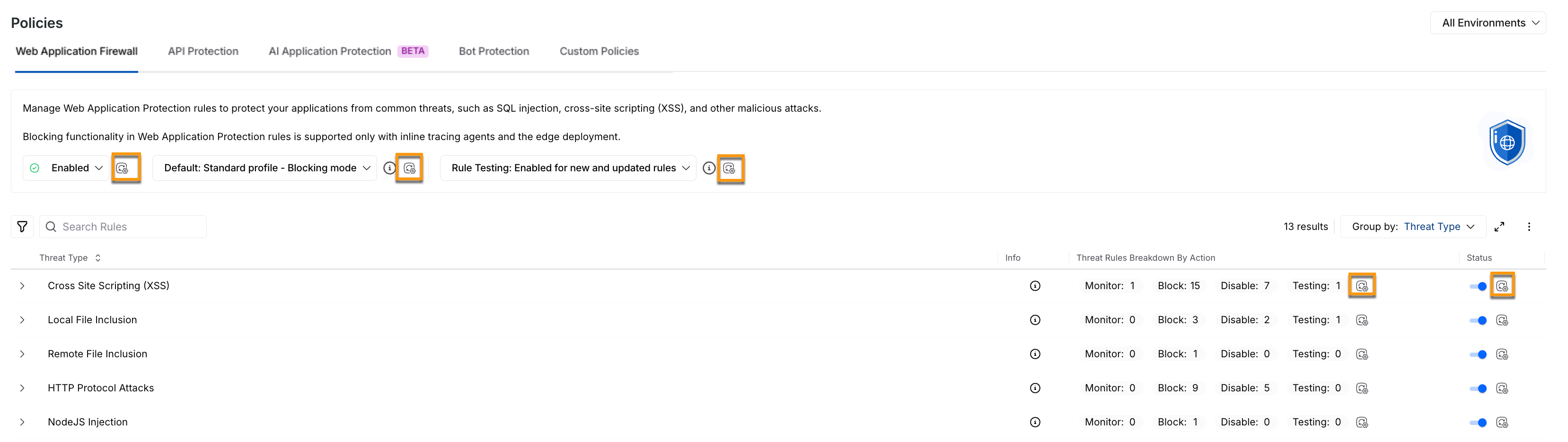
Harness RPA highlights these overrides through its (<img src="https://1414883571-files.gitbook.io/~/files/v0/b/gitbook-x-prod.appspot.com/o/spaces%2Fdr7UJpJrdGkkSGT6AFTu%2Fuploads%2Fgit-blob-d7a485578cf3db4d313d210b44c871b4f6901c11%2Fimage.png?alt=media" alt="" data-size="line">)icon in the WAF Policies tab. These icons are visible:
<figure><img src="https://1414883571-files.gitbook.io/~/files/v0/b/gitbook-x-prod.appspot.com/o/spaces%2Fdr7UJpJrdGkkSGT6AFTu%2Fuploads%2Fgit-blob-b9db02be87fa15aa55b5060e81c4c74e2eda453f%2Ftraceable_protection_policies_overrides_visibility-w1qc7j.png?alt=media" alt="" width="900"><figcaption><p>Identifying Overrides</p></figcaption></figure>

* Corresponding to the **Profile** drop-down in All Environments.
* In the **Action Breakdown** summaries, highlight the number of rules that have been modified.
* Corresponding to the **Status** toggle when threat type enablement differs from the default behavior.
* Corresponding to **Threat Rule(s)** that have a modified action in one or more environments.

***

## Sample Scenario

The following example illustrates how to control the policy inheritance model and overrides provided by WAF policies.

<details>

<summary><strong>Scenario</strong></summary>

You are in the **All Environments** view, and by default, you select the global (standard) profile as **Monitor Mode**. Now, you modify the action for a specific threat rule from *Monitor* to *Block*.

In this scenario, for an environment such as *Production*, whether or not the actions are modified depends on the following:

* If the environment inherits the standard profile (Monitor Mode), the updated action (Block) is also reflected there.
* If the environment has overridden the standard profile, either by selecting a different profile or modifying a rule, the action remains unchanged.

</details>

{% @harness-feedback/feedback %}